
The Catlins – New Zealand’s Forgotten Coast
The Catlins road trip, honestly: Nugget Point at dawn, Cathedral Caves tide windows, penguins at Curio Bay, gravel roads and almost nowhere to stay.
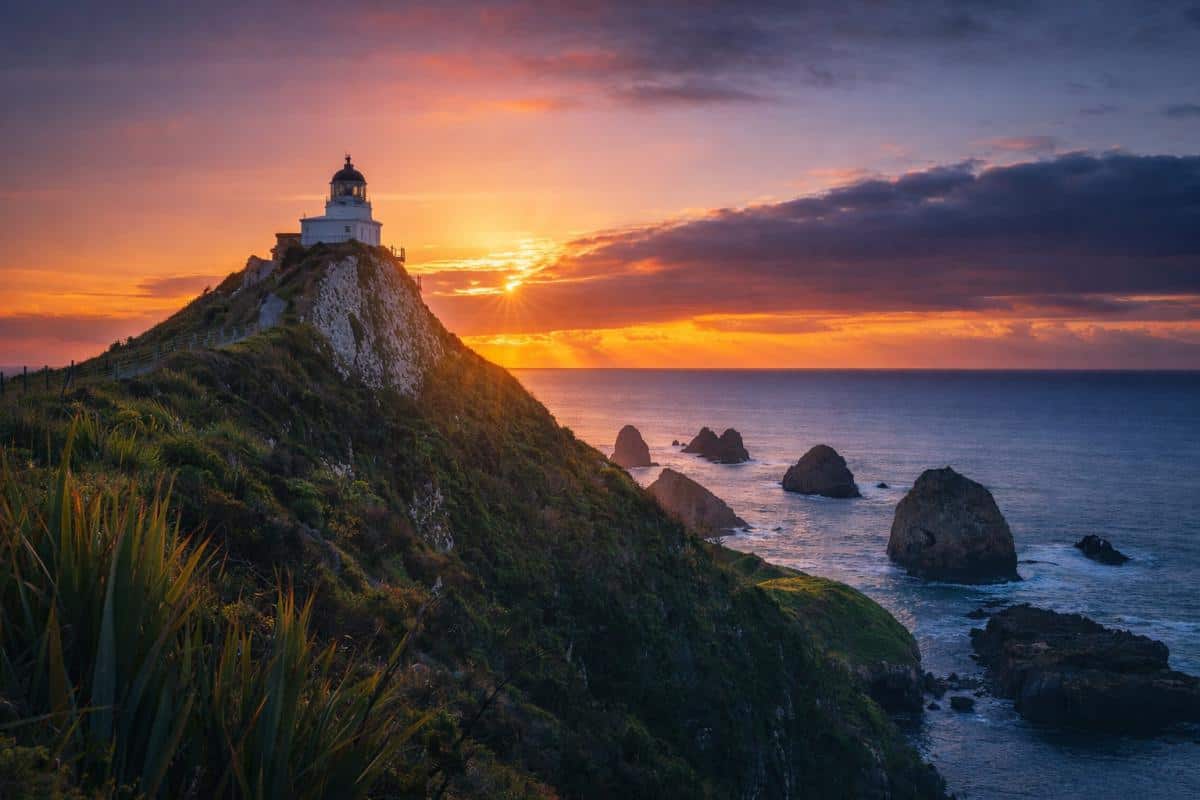
Most people driving between Dunedin and Invercargill take State Highway 1 and are done in three hours. The other road takes two days if you hurry it and a week if you do it properly. Wu ren wen jin (无人问津) — nobody asks the way there — is close to how the Catlins feels on a Tuesday in June, and that is precisely the appeal.
Why Most People Drive Straight Past | 为什么大多数人直接开了过去
The Turn at Balclutha | 巴尔克卢萨的那个路口
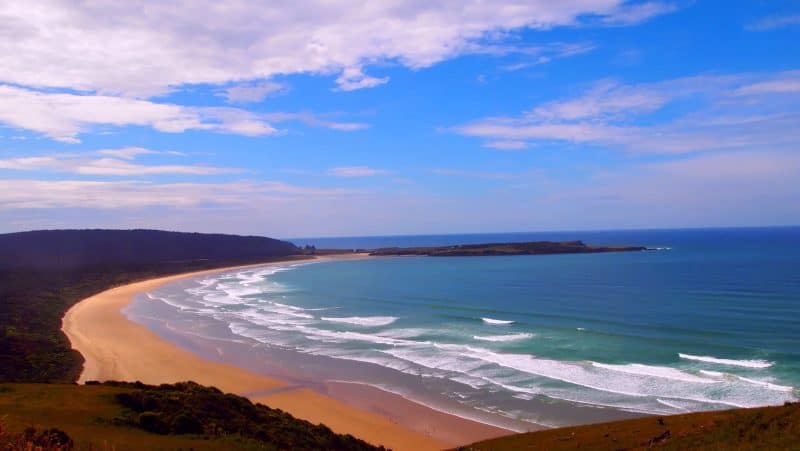
Balclutha (巴尔克卢萨) is where the choice gets made, and most people make it without noticing. The signs point straight ahead for Invercargill, the road is flat and fast, and you are through in three hours.
Turn left instead, onto the Southern Scenic Route, and the character of the drive changes inside twenty minutes. The road narrows. Dairy paddocks give way to gorse and regenerating bush, then to podocarp forest nobody ever cleared because there was no way to get the logs out.
We have driven both. The inland run saves you about two hours on paper. What it costs you is the only stretch of coast in the South Island where you can stand on a beach at midday and see nobody at all.
What the Southern Ocean Does to a Coast | 南大洋如何塑造这片海岸
There is nothing between the Catlins and Antarctica. That single fact explains most of what you will see here – the rata leaning inland at forty-five degrees, the beaches piled with bull kelp as thick as fire hose, the way a clear morning turns into horizontal rain by eleven.
The rock is doing something too. Jurassic sandstone and mudstone lie in tilted layers along this coast, and the sea has been prising them apart, which is why you get caves, blowholes and offshore stacks within a few kilometres of each other.
It also means the swell is serious year-round. These are not swimming beaches, whatever the weather is doing on the day. Porpoise Bay next door is the one place people do go in, and even there the locals watch the rips.
How Long You Actually Need | 到底需要几天
One day is possible and we would not do it again. You end up experiencing the Catlins as a sequence of car parks, and the walks – which are short, but they are the entire point – become something you rush.
Two nights is the honest minimum. That buys you a dawn at Nugget Point (努盖特角), a full day for the middle stretch of falls and caves, and an evening at Curio Bay when the penguins land. Wei yu chou mou (未雨绸缪) — mend the roof before the rain comes — is the right frame for planning it.
Three nights and you can afford to lose one to weather, which you probably will. Build in the spare day and the trip stops feeling like a schedule.
The Road Is Not the Easy Part | 路本身并不轻松
Gravel, Potholes and the Turnoffs Worth Taking | 砂石路、坑洼与值得拐进去的岔路
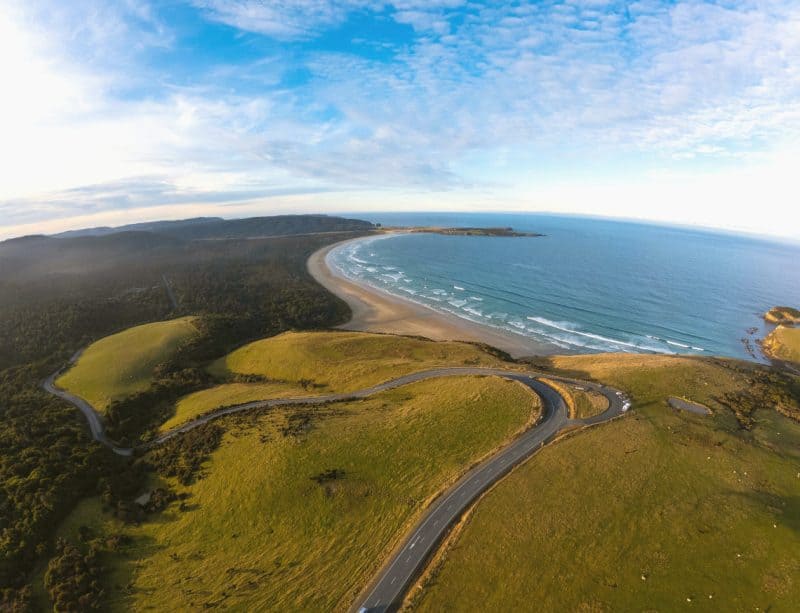
The Southern Scenic Route is sealed the whole way. Almost nothing you actually came to see is on it.
Nugget Point, Jacks Blowhole, Surat Bay, Slope Point, Waipapa Point – every one of them sits at the end of a side road, and most of those side roads are gravel. They are fine in a normal car if you drive them like gravel: slow, off the crown, no sudden braking. They are not fine at eighty. We have seen more than one rental sitting nose-down in the ditch on the Nugget Point road.
Read your rental agreement before you leave Dunedin (但尼丁). Several campervan companies exclude unsealed roads entirely, which technically rules out half the Catlins, and nobody at the depot counter will mention it.
Petrol, Signal and Things You Will Run Out Of | 油、信号,以及会用光的东西
Fill up at Balclutha. Then fill up again at Owaka (奥瓦卡) if the chance comes, because the options thin out fast after that – Papatowai has a pump attached to the store, Fortrose has one, and both keep shop hours rather than running twenty-four-hour card operation.
Phone coverage is patchy in a way that catches people out. You will have bars at Owaka and Curio Bay and close to nothing through the forested middle around Tautuku. Download your maps before you turn off the highway.
Carry some cash. The bigger attractions take card, but a couple of the smaller reserves and campgrounds still run on an honesty box, and the nearest machine might be forty minutes away.
The Stops That Earn Their Place | 真正值得停下来的地方
Nugget Point Before the Sun | 日出之前的努盖特角
Set an alarm. The walk from the car park to the Nugget Point lighthouse is ten minutes on a formed track along a knife-edge ridge, and at first light you get the thing everyone has seen in photographs – the 1870 tower, the line of rock stacks running out to sea, mist sitting in the gaps between them.
By ten there will be forty people on that track, and it is a narrow track.
Take the short detour down to Roaring Bay on the way out. The hide there looks over a beach where yellow-eyed penguins come and go, and the Department of Conservation signage asks you to stay inside it and stay quiet. Ke yu bu ke qiu (可遇不可求) — you can meet it, but you cannot demand it. Some mornings there is simply nothing on the sand.
Two Waterfalls, Two Very Different Walks | 两条瀑布,两种完全不同的步道
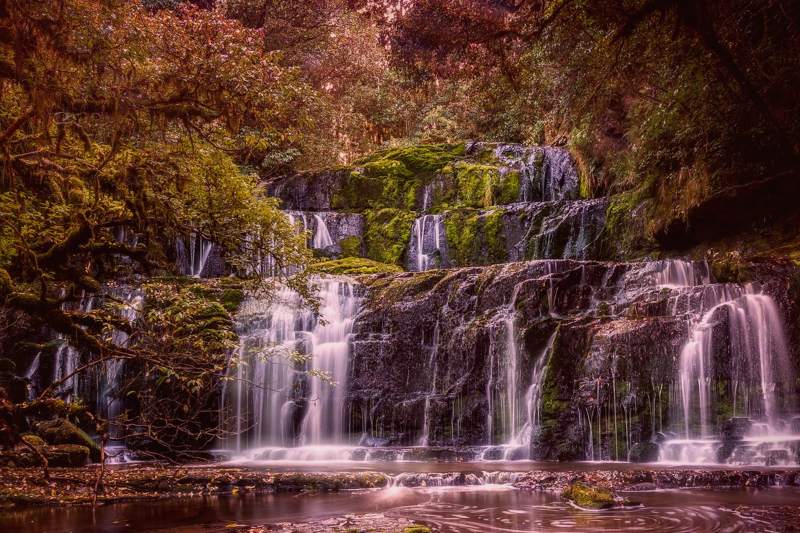
Purakaunui Falls (普拉考努伊瀑布) is the postcard one – three broad tiers dropping about twenty metres through silver beech, ten minutes each way on a track flat enough for a pushchair. It is also the second busiest thing in the Catlins, so go before nine or after four.
McLean Falls (麦克莱恩瀑布) is the better walk. Twenty minutes in, climbing over roots and river stones, the bush closing in and the noise building well before you see any water. The falls are taller, messier and much harder to photograph, which we mean as a compliment.
Wear something on your feet you do not mind soaking. Both tracks hold water for days after rain, and the sandflies at the McLean Falls car park are genuinely bad from November through March. Repellent goes on in the car, not at the trailhead.
Cathedral Caves and the Tide Window | 大教堂洞与潮汐窗口
This is the one stop you cannot improvise. Cathedral Caves opens for roughly two hours either side of low tide, only from late October to the end of May, and only when the sea is behaving. The times are posted at the gate, and they change every day.
From the gate it is a fifteen-minute descent through bush to the beach, then a walk along the sand to two arches about thirty metres high that meet in the middle. Inside, the sound drops away and your torch beam does not reach the roof.
Entry is around ten dollars an adult, collected at the top. Shi bu wo dai (时不我待) — time does not wait for you — applies here in the most literal way. We watched a family arrive forty minutes late on a February afternoon, having driven from Dunedin that morning, and turn straight around.
The Wildlife You Came For | 你为之而来的野生动物
Curio Bay: Penguins on a Jurassic Beach | 好奇湾:侏罗纪海滩上的企鹅
At low tide Curio Bay (好奇湾) exposes a platform of fossilised stumps and fallen trunks, laid down when this coast sat on the edge of Gondwana. Nothing is fenced off or interpreted to death, which is part of why it lands.
The hoiho, or yellow-eyed penguin, comes ashore in the late afternoon and evening, crossing that same platform to reach the flax on the bank. There are only a few thousand left, which makes it among the rarest penguins in the world, and it spooks easily – twenty metres back, and nobody walks down onto the beach while a bird is landing.
Find a spot on the bank and sit. Jing xia xin lai (静下心来) — let the mind settle. They arrive when they arrive, usually inside the last ninety minutes of daylight.
Sea Lions on the Sand at Surat Bay | 苏拉特湾沙滩上的海狮
Fifteen minutes from Owaka, past Newhaven, the road runs out and a sand track leads over the dunes to Surat Bay (苏拉特湾). New Zealand sea lions haul out here most days of the year, and the first time you meet one it is a genuine shock. They are large, they are the exact colour of the sand, and they do not move until you are far closer than you meant to be.
Give them twenty metres and never put yourself between an animal and the water. They can outrun you over the first fifty metres, and a male rearing up on his fore flippers is not posing.
The beach itself is a long grey curve with the Owaka River mouth at one end. On a weekday in winter you will have all of it. Bring the jacket that stops wind rather than the one that stops rain.
Sleeping, Eating and Getting It Wrong | 住宿、吃饭与那些踩过的坑
There Is Almost Nowhere to Stay | 几乎没有地方可以住
This is the practical fact that catches people out. The entire accommodation inventory for a hundred kilometres of coast is roughly this:
– Owaka – a couple of motels and a pub with rooms
– Pounawea and Newhaven – small holiday parks down on the estuary
– Papatowai – a handful of cottages and a campground
– Curio Bay – a campground, some cabins and a scattering of baches
In January it books out, and it books out early. People are reserving Curio Bay in September. Outside the school holidays you can usually find a bed a week ahead, though it might be the last cabin at Pounawea rather than the place you wanted.
The fallback is to base yourself in Balclutha or Invercargill (因弗卡吉尔) and drive in each day. It works. It also costs you the dawns and the evenings, which are the two hours a day this coast is at its best.
Weather, Sandflies and the Days That Do Not Work | 天气、沙蝇与失败的一天
Some days here simply do not come off. The rain arrives sideways off the Southern Ocean, Nugget Point sits inside a cloud, the caves are shut because the swell is up, and no penguin lands while you are watching.
Sui yu er an (随遇而安) — settle into whatever you are given — is not a philosophy we brought with us. It is one this coast taught us on a wet Wednesday at Papatowai with a flat thermos.
What helps: layers rather than one big coat, repellent in the door pocket, and a paper map. The cafes at Owaka keep short and slightly unpredictable hours, and between Balclutha and Fortrose your fallback is a pie warmer.
The upside of a washout is that the coast empties completely. A grey afternoon at Tautuku Bay with the wind flattening the marram grass is not the photograph you came for, but it is closer to what this place is.
We have taken the inland highway since, in a hurry, and it gives you three hours and nothing at all to think about afterwards. The Catlins takes days and hands back a set of very specific small things – a sea lion twitching in its sleep, a torch beam that does not reach the roof of a cave, the sound of a beach with nobody else on it. Bu xu ci xing (不虚此行) — the trip was not wasted.
3 Comments
The Cathedral Caves timing is not an exaggeration. We came down from Dunedin last March, got there about an hour after the window shut and had to eat the whole drive back for nothing. Check the tide table the night before, not on the day.
Took my parents down in April on their first trip out of Auckland and Curio Bay was the part they talked about the whole way home. Dad sat on that bank for an hour and a half and got two hoiho in the end. Your twenty metres point is worth repeating – there were people out on the platform with phones up and the birds just circled and would not come in. Nice too to see the place names written out in Chinese, my mum could actually follow where we had been for once.
Local here, fair write up, but you have gone easy on the Papatowai pump. It is shut plenty of weekends. Fill at Owaka and do not chance it.