
New Zealand’s Seafood Seasons – Bluff Oysters, Whitebait and Crayfish
Bluff oysters open in March, whitebait runs for two months, and crayfish waits on a Kaikoura roadside. When to go, and what it really costs.
The first time we tried to buy whitebait on the West Coast, we did the mental conversion twice and asked the woman behind the counter to say the price again. Bu ke si yi (不可思议) — unbelievable. New Zealand seafood runs on a calendar rather than a shelf, and once you learn to read it the country reorganises itself into a year of things worth driving for.
Learning to Read the Seafood Calendar | 学会看懂海鲜日历
Why the Calendar Beats the Menu | 为什么日历比菜单更重要
Supermarkets will sell you something labelled oyster in November and something labelled crayfish in July, and both will be technically true and quietly disappointing. The seafood worth planning around does not sit in a chiller all year. It arrives, it gets talked about for a few weeks, and then it goes.
That is the first adjustment for anyone who grew up where the fish counter looked identical in every month. The question is not what you feel like eating. It is what is running now, and where you have to be standing to get it.
Shun shi er shi (顺时而食) — eat with the season — is not a wellness slogan here. It is just how the supply works. Miss the window and you wait a year.
The Shock of Abundance | 丰盛带来的震撼
What still catches us out, a decade in, is the price of a sack of live green-lipped mussels. Two kilos for about eight dollars at a Christchurch supermarket, in a country where a plate of six back home would cost more than the whole sack.
Some of it maps onto nothing we knew. Whitebait especially — translucent, barely a finger long, eaten whole in an egg batter — has no equivalent we can name.
The abundance is real but it is not spread evenly. Mussels are cheap because they are farmed at scale in the Marlborough Sounds (马尔堡峡湾). Crayfish has never been cheap anywhere in this country, and no calendar changes that.
March to August: The Bluff Oyster Window | 三月到八月:布拉夫生蚝季
What Makes a Bluff Oyster Different | 布拉夫生蚝的与众不同
Bluff oysters are not the rock oysters that grow on Northland pilings. They are dredge oysters, scraped off the floor of Foveaux Strait (福沃海峡) in water cold enough to make the whole enterprise sound like a bad idea.
The season opens on 1 March and can run to late August, though the quota is often landed well before the calendar closes. Flatter and rounder than a Pacific oyster, the meat denser and heavier in the shell.
The taste is the part people underestimate. Less brine, more mineral, closer to the sea floor than the surface, and a finish that stays for a good minute. They are expensive, and the price climbs as the season runs down.
Eating Them at the Source | 在产地吃生蚝
Bluff sits half an hour south of Invercargill on State Highway 1, and we will be honest: the town is small, weather-beaten, and puts on a show for nobody. Do not arrive expecting a waterfront dining strip.
The Bluff Oyster and Food Festival runs one Saturday in May, tickets go in minutes, and the queue is outdoors in a wind that comes straight off the strait.
Outside the festival, buy them by the dozen from a fish shop and eat them in the car park with a plastic fork. Reckon on thirty dollars a dozen opened, more early on. Wu ke ti dai (无可替代) — there is no substitute — was what an Invercargill fishmonger told us when we asked what to buy instead in December.
Whitebait and the Fritter Arguments | 白饭鱼与炸饼之争
A Season With Rules Attached | 附带规则的季节
Whitebait season runs from 1 September to 30 October across most of the country, and unlike the oysters, this one carries real conservation weight. Four of the five galaxiid species that make up the catch are classified as threatened.
The whitebaiting regulations published by the Department of Conservation cover net dimensions, how close you can fish to a river mouth, and how a stand may be worked. They were tightened in 2021 and people still argue about them from the Mokau to the Hokitika.
Ru xiang sui su (入乡随俗) — follow the customs of the place you are in — applies almost literally. Whitebaiting stands are inherited, defended, and occasionally the subject of grudges older than anyone standing on them. Do not park in front of one.
The Fritter Arguments | 炸饼之争
Ask three Coasters how to make a fritter and you will get three recipes and one shared conviction: whatever you were about to add, do not.
The orthodox position is whitebait, egg, salt, nothing else. Some insist on egg white only, so the fritter sets pale and the bait stays visible. Others use the whole egg and accept a yellower result. Flour is contentious. Onion is close to heresy. Served on white bread with a squeeze of lemon is the standard.
Ge zhi yi ci (各执一词) — everyone holds to their own version. We ate both on the same coast in the same week and cannot declare a winner. The whole-egg one held together better under a fork. The egg-white one tasted more like the fish.
What It Costs and Whether It Is Worth It | 价格与值不值
Prices swing with the run. In a good week you might find it in a Hokitika (霍基蒂卡) shop for around one hundred and thirty dollars a kilogram; in a lean season we have watched it climb past two hundred. A fritter in a cafe sits near twenty-five dollars, a lot for something the size of a coaster.
Here is the honest part. Plenty of people try it once and quietly wonder what the fuss was about. The flavour is delicate almost to the point of shyness — faintly sweet, a little grassy, more texture than taste.
The fuss is not really about flavour at all. It is about a two-month window, a cold river at six in the morning, and a family who has worked the same stand for forty years.
Crayfish, Mussels and the Coastal Staples | 龙虾、青口与海岸常客
The Kaikoura Caravans | 凯库拉的路边餐车
North of Kaikoura (凯库拉) the road runs so close to the water that the fur seals stop bothering to move. Somewhere along that stretch of State Highway 1 you will pass a caravan with a hand-painted sign and a queue.
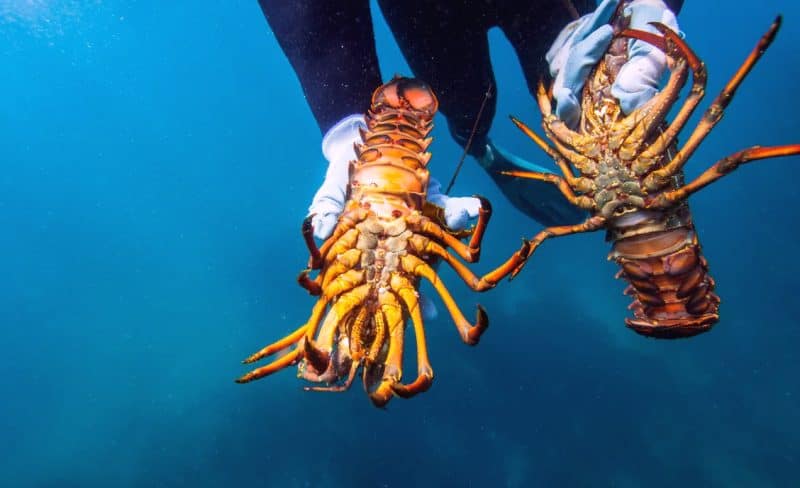
Nin’s Bin has been parked near Rakautara for decades. You order at the window, wait longer than you expected, and walk away with half a crayfish, split and grilled, and nowhere to sit. Reckon on sixty to eighty dollars for a half. Crayfish is a luxury purchase in this country and a roadside caravan does not change the arithmetic.
Eat it on the rocks with the wind going sideways and your fingers getting cold. It is better outside.
Havelock and the Green-Lipped Mussel | 哈弗洛克与青口贝
Havelock sits at the head of the Pelorus Sound and calls itself the green-lipped mussel capital of the world, a claim a town of a few hundred can make when it happens to be true. The farms fill the water behind it, long parallel rows visible from the Queen Charlotte Drive.
Mussels are the one item here available every month, which is why they end up in our kitchen more than anything else on the list. Steamed with ginger and spring onion, lid on, four minutes, shells open. Hui wei wu qiong (回味无穷) — the aftertaste lingers — and the broth in the bottom of the pot is better than the mussels.
Havelock itself is a highway stop and a marina. Do not build a weekend around it. Build a lunch.
Paua, and the Rules Around It | 鲍鱼与相关规定
Paua needs no introduction in a Chinese kitchen. Bao yu (鲍鱼) — abalone — the thing that costs a fortune dried and gets served at weddings to make a point.
Here it clings to rock on the open coast and the rules are tight. Recreational gatherers are limited to ten black paua a day in most of the country, the minimum shell length is 125 millimetres, and taking paua on scuba is not permitted. Limits and closures vary by region and they change, so check the current Ministry for Primary Industries rules for the stretch of coast you are on rather than trusting an article, including this one.
Fishery officers do patrol. The beds do not recover quickly, which is the whole reason the numbers are what they are.
Planning a Year Around the Catch | 围绕海鲜规划一年
A Month-by-Month Shortlist | 逐月清单
If you are building a year of driving around this, here is roughly how it falls:
– March to August: Bluff oysters, best in the first six weeks, Invercargill and Bluff
– September and October: whitebait, West Coast rivers and the lower North Island
– Spring into autumn: scallops in the Coromandel and Marlborough, subject to closures
– Every month: green-lipped mussels out of the Marlborough Sounds, and crayfish whenever you can justify it
– Late spring onward: kina, if you have the stomach for it
Two warnings. Scallop fisheries have been closed across several areas in recent years and that keeps shifting, so check before planning around them. And kan tian chi fan (看天吃饭) — you eat according to the weather. Boats do not go out in a swell, caravans do not open, and whitebait does not run in a flooded river.
Gathering Your Own, Honestly | 自己动手采集,说实话
Gathering your own sounds romantic right up until you are standing in a Wellington southerly at low tide with numb fingers and a bucket holding four mussels.
The practicalities are dull and they matter. Check the tide chart and go within two hours either side of low. Wear grip, because wet rock is worse than it looks and the fall is always onto shell. Carry a gauge rather than guessing. Daily limits are per person and not generous.
Shi ke er zhi (适可而止) — know when to stop. Take less than the limit. Leave the small ones where they are. Half the reason this calendar still works is that most people gathering on these rocks have done it politely for generations.
We have missed the oyster window twice now, both times by a fortnight, for reasons that seemed important then. Lai ri fang chang (来日方长) — there are plenty of days ahead — is the polite thing to say about that, and it is also how you end up eating supermarket crayfish in July. The calendar is not a suggestion. Put March in your phone.
3 Comments
Good call sending people to MPI for the paua rules rather than stating them flat. The limits shift around here more than most folk realise and there are closures on this coast that catch visitors out every summer. Would add that the gauge is not optional – measuring by eye is how people end up with a very expensive afternoon.
The mussel price thing is so real. I sent a photo of an eight dollar sack to my mum in Guangzhou and she thought I had cropped out a decimal point. Took me about three years to stop feeling like I was getting away with something at the checkout. On the whitebait though I am with your honest paragraph – I paid for a fritter in Greymouth, ate it in about four bites, and mostly tasted the egg. Still glad I did it. Going back for the Bluff oysters in autumn instead, that one I understood immediately.
Nin’s Bin in the wind with cold fingers is exactly right, and yes it is always better outside.