
DOC Huts and Campsites – Sleeping in New Zealand’s Backcountry
Around 950 DOC huts and 200 campsites, explained: the four hut grades, the Backcountry Hut Pass, Great Walk bookings and what to pack for night one.
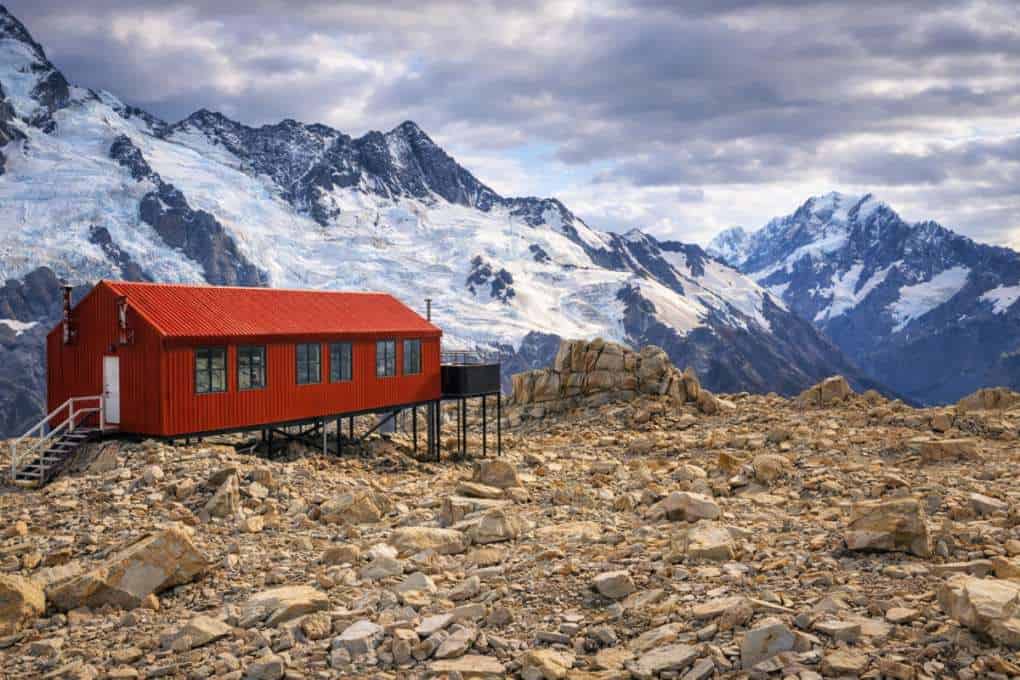
The first time we stayed in a DOC hut we arrived at four in the afternoon carrying a pillow, which the four people already in the bunkroom were far too polite to laugh at. Su wei mou mian (素未谋面) — complete strangers — and by dark we were passing round a bag of scroggin and comparing blisters. Around 950 huts and 200 campsites are sitting out there tonight, and almost none of it works the way a motel booking works.
The Shape of the Network | 保护部住宿网络的规模
Around 950 Huts and 200 Campsites | 约九百五十间小屋,两百个营地
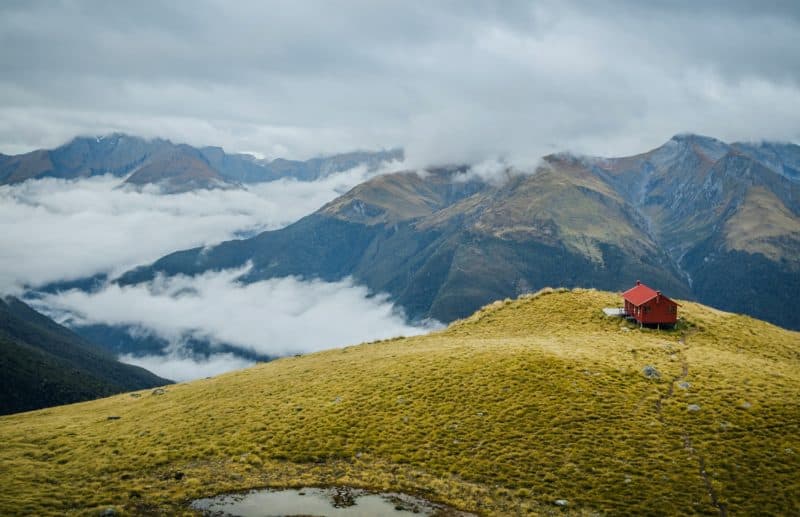
The Department of Conservation looks after roughly 950 huts and around 200 campsites, which makes it the largest accommodation operator in the country by a distance, and the least interested in your comfort. The network runs from Te Paki at the top of the North Island down to Rakiura (斯图尔特岛), where the huts smell of damp beech and the kiwi are noisier than the snorers.
Some huts sit twenty minutes from a car park. Others take two days to reach and a helicopter to resupply. Most were built for deer cullers, tramping clubs or the old Forest Service, and DOC inherited them along with the obligation to keep the roofs on.
That inheritance shows. You will find 1960s six-bunk boxes with a wood burner and a long drop, and you will find near-new forty-bunk lodges with flush toilets, and both of them are called huts.
If You Have Only Ever Stayed in Motels | 如果你只住过汽车旅馆
Here is the adjustment. There is no reception, no key, and no one to ring when the tap does not run – because there is no tap. There is a tank, and if it is low in February you walk to the creek.
Zi li geng sheng (自力更生) — self-reliance — is not a philosophy out here, it is the operating model. You carry your own sleeping bag, your own food, your own cooker in most cases, and you carry your rubbish back out, tea bags included.
What you are paying for is the roof, the bunk platform, the water tank and the toilet. Everything else is your problem, which sounds bleak until the first night you cook noodles while rain hammers the iron roof and you realise you would not swap it for a motel on the main road at Turangi.
Four Grades of Hut, and What You Actually Get | 小屋的四个等级
Basic and Standard: The Bones of the Network | 基本级与标准级:网络的骨架
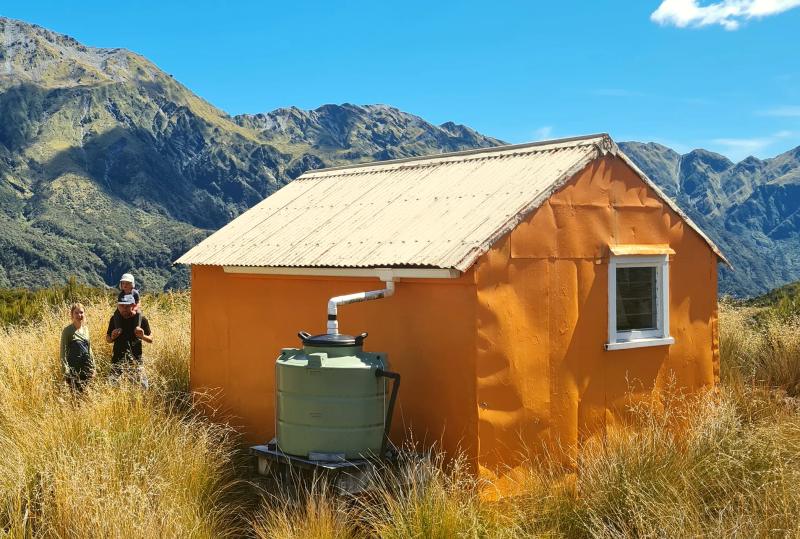
Basic huts carry no fee at all. Two to six bunks or a sleeping platform, no heating, sometimes no mattresses, a rainwater tank if you are lucky. Bivvies sit in this tier too – orange fibreglass pods that fit two people who like each other.
Standard huts are the workhorses and the bulk of what you will actually sleep in. Bunks with mattresses, a wood burner or a potbelly in the colder ones, a water supply, a long drop out the back and a hut book to sign. No cooking gear, no lighting, no warden.
Wu zang ju quan (五脏俱全) — everything essential is there — and nothing that is not. Standard huts cannot be booked. You turn up, and if the bunks are full you sleep on the floor. That is the actual rule, not a courtesy.
Serviced Huts: Mattresses and a Warden | 服务级小屋:床垫与管理员
Serviced huts sit at the top of the non-Great-Walk tier and they are the ones that surprise motel people most. Mattresses on every bunk, heating with fuel supplied, a water supply, toilets that sometimes flush, and often gas rings so you can leave the cooker at home – though we never do.
Angelus Hut (安吉勒斯小屋) in Nelson Lakes is the one we send people to. Twenty-eight bunks at 1,650 metres, a warden through summer, and a tarn outside that goes glassy at about eight in the evening.
Some serviced huts take bookings over summer and some do not, which is exactly the kind of inconsistency that catches people out. Check the individual hut page rather than assuming – the Department of Conservation hut listings spell out the category, the fee and whether a booking is required.
Great Walk Huts: A Different Animal | 大步道小屋:完全不同的物种
Great Walk huts are a separate system wearing the same word. Through the main season, roughly late October to late April, they are bookable, staffed by wardens who run an evening talk, and fitted with gas cooking, filtered water, flush or composting toilets and lighting.
They are also the most expensive beds DOC sells. Depending on the track and whether you are a New Zealand resident, a bunk runs from around fifty dollars to well over a hundred a night, and the resident rate is worth having your proof ready for.
Yi fen qian yi fen huo (一分钱一分货) — you get what you pay for — holds up here, mostly. What you are buying is a guaranteed bed on a track that would otherwise be chaos. Outside the main season the same huts drop back a category, lose the warden and the gas, and cost a fraction.
Paying for Your Bunk | 如何为床位付费
The Backcountry Hut Pass Versus Per-Night Tickets | 后山小屋通行证还是单晚票
There are two ways to pay for standard and serviced huts. Hut tickets are small paper vouchers, five dollars each, bought from any DOC visitor centre or an outdoor shop. A standard hut costs one ticket a night, a serviced hut three. You date the ticket, tear it, and drop it in the box on the wall.
The Backcountry Hut Pass is the annual alternative – somewhere around a hundred and twenty dollars for an adult at the time of writing – and it covers unlimited nights in standard and serviced huts for twelve months. Great Walk huts are excluded, as are a handful of bookable huts.
The maths is not complicated. Eight or nine nights a year and the pass wins. We bought ours the summer we did four nights around Arthur’s Pass (亚瑟隘口) in one week, and we have never gone back to tickets.
Great Walk Bookings Go Fast | 大步道预订:手慢无
Bookings for the following Great Walk season open in winter, usually a morning in May or June, and DOC announces the date well in advance. Be at a laptop, already logged in, with your dates and your party decided.
Shou man wu (手慢无) — slow hands get nothing. The Milford Track is the extreme case: the good January weekends are gone in minutes and the whole season fills within days. Routeburn and Kepler are not far behind.
If you miss out, cancellations trickle back into the system all season and the booking page updates live, so it is worth a look on a Tuesday night in October. Shoulder season – late October, or the second half of April – is genuinely easier to book, colder to walk, and in our experience better. Fewer boots on the track, and the huts are half empty.
DOC Campsites Are Not Holiday Parks | 保护部营地不是度假公园
The Four Campsite Grades | 营地的四个等级
DOC campsites run on their own four-tier scale, and the words do not mean what they mean anywhere else. Basic campsites are free or close to it: a flat spot, a long drop, maybe a stream. Standard adds a water supply and vehicle access. Scenic is serviced the same as standard but sits somewhere worth the drive.
Serviced campsites are the ones with flush toilets, hot showers, kitchens and powered sites in some cases, and they run roughly twenty to thirty dollars a person a night.
Totaranui in Abel Tasman (亚伯塔斯曼) is the serviced one everybody knows – hundreds of sites on golden sand, allocated by ballot for the Christmas period since forever. Most DOC campsites are nothing like it. Most are a gravel loop under manuka with six other vans and no phone reception.
What You Give Up, and What You Get | 失去什么,得到什么
A holiday park gives you a laundry, a camp kitchen with a working fridge, wifi, a playground and someone at the desk who will lend you a bottle opener. A DOC campsite gives you none of that, and in exchange puts you somewhere a holiday park could never be built.
Feng can lu su (风餐露宿) — eating in the wind, sleeping in the dew — is the honest version. There will be sandflies on the West Coast and they will find you at dusk whatever you have sprayed on. The long drops in midsummer are what they are.
The trade is still worth making. Twelve dollars a night at a lakeside site with nobody else in it beats sixty in a paddock behind a service station, and no one in the next tent is watching television at eleven.
Turning Up Like You Have Done This Before | 像老手一样上山
The Pack, and What the Hut Will Not Have | 打包清单:小屋没有的东西
The hut supplies the roof, the bunk and usually the mattress. Everything on your body and in your pack is yours to organise.
You bei wu huan (有备无患) — prepared means nothing goes wrong — so, the short list:
– A sleeping bag, always. Mattresses are bare vinyl and there are no blankets.
– A cooker and fuel, unless you have confirmed the hut has gas. Matches or a lighter regardless.
– A head torch. There is no lighting in standard huts and none at all outside them.
– Enough food for one extra day, because rivers come up.
– Rubbish bags. Everything you carry in comes out with you.
Then add earplugs. We are not joking about the earplugs. A twenty-bunk hut in February contains at least one person who will change how you think about sleep, and the walls are plywood.
Hut Etiquette and the Intentions System | 小屋礼仪与行程意向系统
Ru xiang sui su (入乡随俗) — do as the regulars do. Boots off at the door. Take one bunk, do not spread across two. Wet gear on the line, not on someone else’s mattress. Cook, eat, wash your pot straight away. If you are up at five for a long day, pack outside rather than in the bunkroom.
Sign the hut book. It is not a visitor guestbook – it is the record that tells a search party which way you went, and it takes ten seconds.
The intentions part happens before you leave. Tell a specific person where you are going, which huts, and the date you will call them, and tell them what to do if you do not. Not a group chat. One named person with a deadline. The Mountain Safety Council publishes a proper trip planning process for exactly this, and DOC visitor centres hire out personal locator beacons for around ten dollars a trip. Take one.
Bu liu hen ji (不留痕迹) — leave no trace — is the whole contract, and it is the reason the network still works after sixty years of strangers letting themselves in. Sweep the floor, close the door, carry out what you carried in. More than a thousand of these places are empty tonight with a dry mattress and a view out the window, and the only thing between you and one of them is a five dollar ticket and a walk.
4 Comments
Earplugs. Cannot stress this enough. Did Angelus in January and the fella on the bunk below me could have started a chainsaw and I would not have noticed the difference.
Really useful, thanks. My parents are coming out in March and they have only ever stayed in hotels, so the bit about no tap and no reception is exactly the conversation I need to have with them before I book anything. Would you say a standard hut is too much of a jump for people in their sixties, or should we stick to serviced for the first one?
Good rundown but I would push back a bit on the hut pass maths. Eight or nine nights is right if you are mostly in standard huts, but if you favour serviced ones it pays for itself in about four, because serviced is three tickets a night not one. Also worth saying the pass does not cover every bookable hut even outside Great Walk season – that caught me out a couple of summers ago and I ended up paying twice. Otherwise spot on about the hut book. Half the people I meet up there do not bother signing it and they have no idea what it is actually for.
We took the second half of April on the Kepler off the back of advice like this and it was the best call we made all trip. Half empty huts, no warden talk but honestly we did not miss it, and it cost a fraction of peak season. Very cold at night though – take a proper bag, not the summer one.