
Napier and Hawke’s Bay – Art Deco Streets and Wine Country
The Art Deco quarter takes one afternoon. The gannets, the Gimblett Gravels and the flat cycle trails take three days. Here is how we plan Napier.
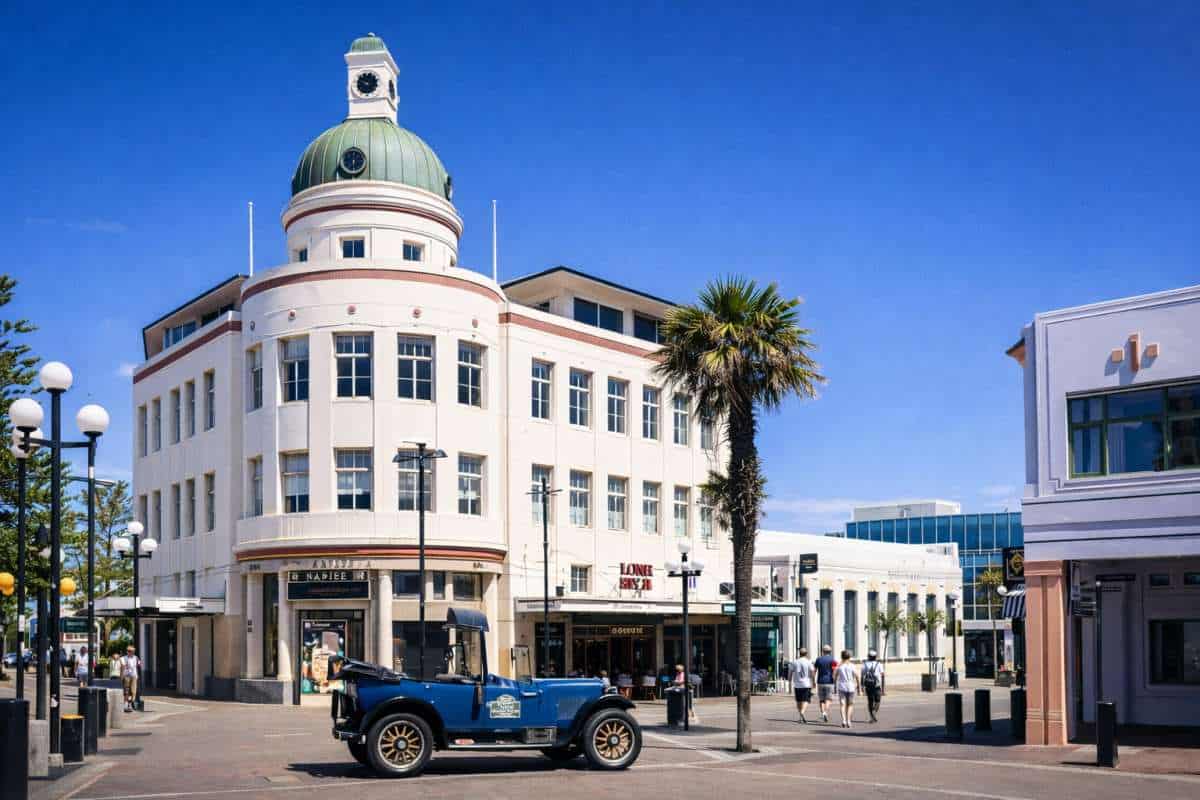
Every New Zealand town has a story about why it looks the way it does. Napier (纳皮尔) has the most violent one. Two and a half minutes of shaking in 1931 took the city down, and what went back up was a small, sunlit experiment in the architecture of that exact moment. We have been back four or five times now, and it keeps rearranging itself in our heads.
The Two and a Half Minutes That Built a City | 建成一座城市的两分半钟
February 1931, and What the Sea Gave Back | 1931年二月,以及大海归还的土地
At 10.47 on the morning of 3 February 1931, the ground under Hawke’s Bay (霍克斯湾) moved for about two and a half minutes. Fires started in the chemist shops on Hastings Street and took what the shaking had left. By the end of the week 256 people were dead, and it remains New Zealand’s deadliest natural disaster.
The stranger part happened underneath. The seabed lifted around two metres and the Ahuriri Lagoon simply drained, leaving roughly four thousand hectares of new land in an afternoon.
The airport sits on it, and so does the industrial flat you cross coming in from the north – which explains why the approach to Napier is so unpromising and the centre so good.
Why the Rebuild Looks Like This | 为什么重建是这个样子
Sai weng shi ma (塞翁失马) — the old man lost his horse, and it turned out to be luck — is roughly the shape of Napier’s twentieth century.
The rebuild ran fast, mostly 1931 to 1933, at the exact moment Art Deco was what architects drew. Four local firms pooled their staff into the Associated Architects and worked to shared rules, which is why the streets hold together rather than argue.
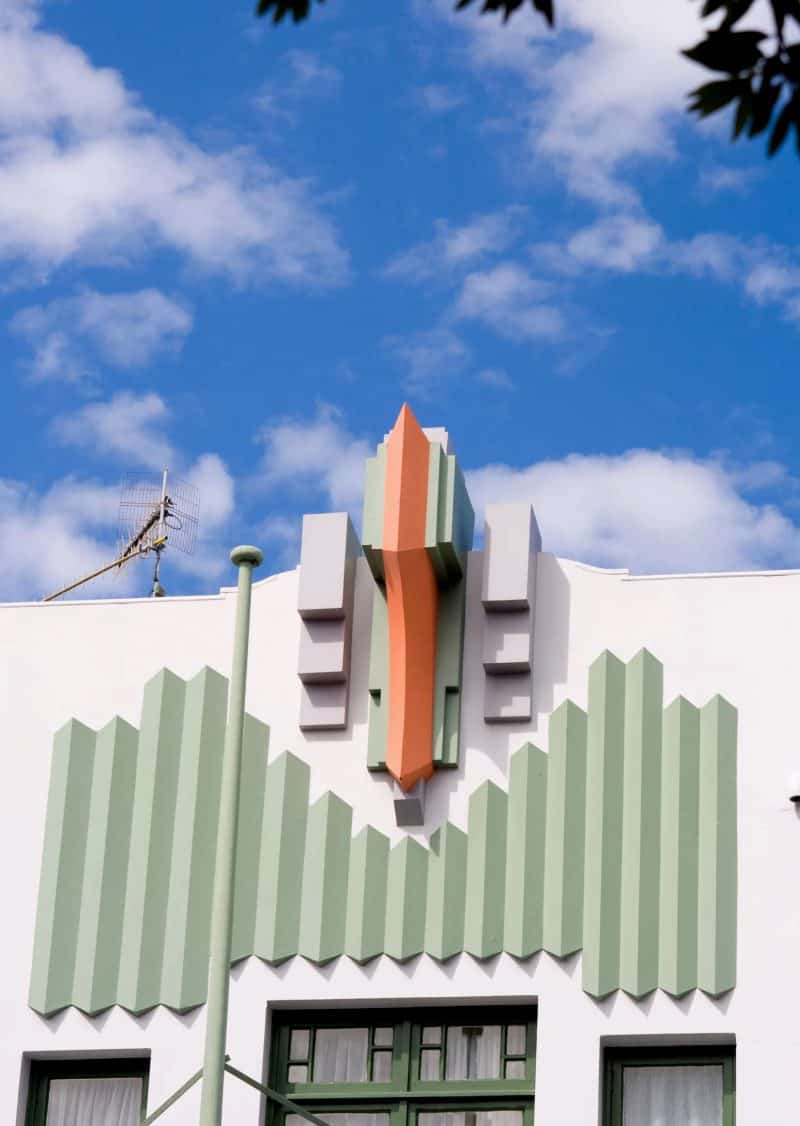
The rules were structural before they were decorative. Two storeys, not four. Light parapets. The heavy verandahs that had collapsed onto people were replaced with cantilevered ones. Reinforced concrete throughout. The zigzags, sunbursts and kowhaiwhai motifs came afterwards, applied to a frame designed not to fall on anyone.
Walking the Deco Blocks | 走完装饰艺术的几个街区
Here is the honest bit. The Deco quarter is small – six or seven blocks around Emerson, Tennyson, Hastings and Dalton Streets, walkable in an afternoon.
Yi bu yi jing (移步换景) — the view changes with every step — but only if you look up. Ground floors have been renovated into whatever the current tenant needed, so most visitors spend twenty minutes staring at shopfronts wondering what the fuss is about. The Deco lives in the upper storeys.
Start at the Daily Telegraph Building on Tennyson Street. The Municipal Theatre next door still runs shows. The Art Deco Trust walk costs around $30 and we would pay it – the buildings get far more interesting once someone tells you which architect was showing off.
The Napier Behind the Facades | 立面背后的纳皮尔
Marine Parade, and Why You Should Not Swim | 海滨大道,以及为什么别下水
Marine Parade (海滨大道) runs the length of the seafront under a double row of Norfolk pines that were planted before the quake and survived it. At seven in the morning, shingle grinding under the swell and the Sound Shell empty, it is one of the better urban walks in the country.
It is not a swimming beach. The shingle drops away steeply within a few metres of the waterline and the undertow is serious. Locals do not swim there and the signs are not decorative. For water, drive twenty minutes north to Waipatiki or south to Waimarama.
The National Aquarium is fine rather than essential, and on a hot February afternoon it is air conditioning with kingfish.
Ahuriri, Where the Town Eats | 阿胡里里:本地人吃饭的地方
Ahuriri (阿胡里里) is the old port ten minutes north, and it is where we end up every evening. West Quay is a row of converted wool stores facing the water – working industrial stock with restaurants pushed into it, which gives the strip an improvised feel we like.
The National Tobacco Company Building is up here on Bridge Street, and it may be the best single building in the district. Louis Hay designed it in 1932, roses and raupo carved around a curved entrance. If you photograph one door in Hawke’s Bay, photograph that one.
Bluff Hill sits above it all, and the lookout over the port is worth the five minutes it takes to drive up.
The Gannets at Cape Kidnappers | 开普基德纳普斯的塘鹅
Twenty Thousand Birds on a Cliff Edge | 悬崖边的两万只鸟
Cape Kidnappers (开普基德纳普斯) is the finger of white cliff closing off the southern end of the bay. On the tip, on a plateau with a drop on three sides, sits the largest mainland gannet colony in the world, north of twenty thousand birds at peak.
They arrive in July, lay through spring, and the chicks hatch from early November. The colony is generally closed from July until late October while the birds settle, so check the reserve at the Cape before you commit to dates. Early November to late February is the window.
Nobody prepares you for the noise, or for the fact that the smell of twenty thousand gannets reaches you well before the birds do.
Tractor, Boots, or 4WD | 拖拉机、徒步鞋,还是四驱车
Kan tian chi fan (看天吃饭) — you eat according to the weather. Getting out to the colony is governed by the tide, and there is no arguing with it. Three options:
– Walk the beach from Clifton. Eight kilometres each way under the cliffs, about five hours return, and free. Start no earlier than three hours after high tide and turn back within ninety minutes of low tide, or the sea closes the route behind you.
– The tractor-trailer trip from Clifton, running since the 1950s. Roughly $60 to $70 an adult for four hours, and the one we send people on.
– An overland 4WD tour across the farmland. Costs more, ignores the tide.
Take water and a hat whichever you pick. There is no shade on that beach.
Wine Country on an Old Riverbed | 长在旧河床上的葡萄酒之乡
The Gravels That Changed the Region | 改变了整个产区的砾石
Inland from Hastings, the Ngaruroro River abandoned a stretch of country in a flood in the 1860s and left about eight hundred hectares of stones behind. Nobody wanted it. It was quarried for road metal for a century.
The Gimblett Gravels (金布利特砾石区) are now the most argued-over dirt in New Zealand wine. The stones hold the day’s heat and give it back overnight, which ripens syrah and cabernet that struggle nearly everywhere else in the country.
Hawke’s Bay is also the country’s oldest wine region – the Marist brothers planted at Mission Estate in 1851 and it still pours at Taradale. If you have wondered why so many good New Zealand reds come off one flat, unremarkable paddock, that is the answer.
Cellar Doors Worth the Detour | 值得绕路的酒庄
Man tiao si li (慢条斯理) — unhurried, one thing at a time. Three cellar doors in a day is plenty, and four is a mistake we have made.
Tasting fees run about $10 to $20 and are usually credited against a purchase. Book ahead in January and February; do not bother the rest of the year. Most places open around eleven and start winding up at four, so arrive at half past four and you will be tasting in a car park.
Church Road at Taradale has the underground cellars and the history. Craggy Range sits under Te Mata Peak with the setting. Elephant Hill at Te Awanga looks straight out to sea. Say at the door if someone is driving all day – the good ones will pour small and stop refilling.
Te Mata Peak and the Tukituki Valley | 蒂马塔峰与图基图基河谷
Te Mata Peak (蒂马塔峰) is 399 metres and you can drive to the top, which feels like cheating and is worth doing anyway. The road climbs through Te Mata Park in switchbacks, and the last stretch runs a ridge with a long drop either side that makes passengers go quiet.
From the top the whole region arrives at once – the Heretaunga Plains in orchard blocks and vine rows, Napier and Hastings as two smudges, and on a clear winter morning Ruapehu on the horizon a hundred and sixty kilometres off.
Paragliders launch off the western face most fine afternoons. Below, the Tukituki runs through Havelock North, the prettiest of the three towns and the one where we would stay if the budget allowed.
Making Three Days Work | 如何安排三天

The Flattest Cycling in New Zealand | 新西兰最平坦的骑行
Yi ma ping chuan (一马平川) — flat country you could gallop a horse across. The Hawke’s Bay Trails cover about two hundred kilometres of sealed, mostly traffic-free path across the plains, and the elevation profile is close to a straight line.
This is what turns a two-day visit into a three-day one. Ride the coast from Napier to Clive, up the Tukituki stopbanks to Havelock North, across to the Hastings wineries and back, without once getting off to push.
Hire runs around $45 to $55 a day, or $85 to $100 for an e-bike. Take the e-bike. Not for the hills – there are none – but because the afternoon wind off the bay is usually against you on the way home.
When to Come, and What Nobody Tells You | 何时前来,以及没人会告诉你的事
February is the obvious month. The Art Deco Festival runs around the anniversary of the quake: vintage cars along Marine Parade, a great many people in 1930s dress, and a commitment to the theme that is genuinely charming for about two days. Ren shan ren hai (人山人海) — a mountain of people, a sea of people. Book accommodation six months out or do not come. There is a smaller winter version in July that we quietly prefer.
Then the things nobody puts in the brochure. Cruise ships dock through summer and can put two thousand people into six blocks of Deco in a morning, so check the port schedule and walk early. The region is still repairing bridges, orchards and trail sections after the February 2023 cyclone, so confirm trail status before you ride. And you need a car for anything past the city centre. The buses will not take you to a cellar door.
What pulls us back is not the buildings in the end. It is that a town this pleasant to spend three days in exists because of the worst morning in its history, and it has never once pretended otherwise. Lai ri fang chang (来日方长) — there are plenty of days ahead. We still have not ridden the Water Ride, and the gannets will be back in November.
3 Comments
Napier local here. Spot on about the shingle, we get visitors every summer who ignore the signs down the Sound Shell end and it never ends well. One thing to add though, the tractor trip books out solid over the Christmas period, so if you are coming between Boxing Day and mid January you want to be ringing them in October, not the week before. Otherwise a fair write up, and yes, always check the cruise schedule.
The bit about the Deco only being in the upper storeys is so true. Did the walk with my parents last April and Dad spent the first block asking why we had bothered coming, then someone pointed up. Booking the guided one next time.
Rode the trails in March on a hire e-bike and can confirm the wind. Went out to Clive feeling like an athlete and came back at about walking pace with the assist on full. Te Mata Peak in the evening was the highlight for us, got up there around half seven and had the whole ridge to ourselves.