Lake Tekapo Stargazing – Nights Under the Mackenzie Dark Sky
Mount John tours, moon phase over weather, and what you can see from the Tekapo lakefront with no equipment at all. Written from a lot of cold nights.
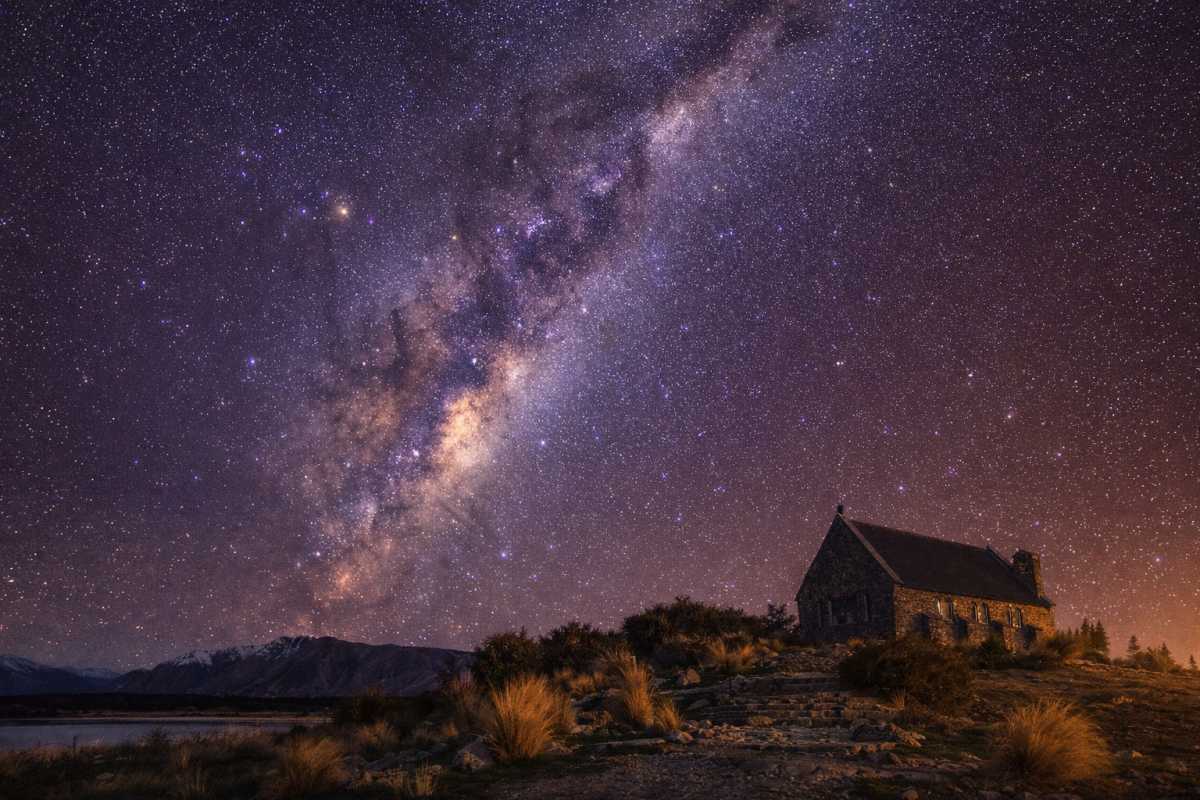
The first time we drove into the Mackenzie after dark we pulled over on State Highway 8 for a two-minute look and stayed forty. Tai tou jian xing (抬头见星) – look up and there they are – except there were more of them than any of us had ever seen at once. Lake Tekapo is where most visitors meet a genuinely dark sky for the first time, and it rewards planning more than almost any other night out here.
What Makes the Mackenzie Sky Different | 麦肯锡星空为何与众不同
The Reserve, and What It Actually Protects | 暗空保护区究竟保护什么
A dark sky reserve is not a park you can walk into. The Aoraki Mackenzie International Dark Sky Reserve covers around 4,300 square kilometres of the Mackenzie Basin (麦肯锡盆地) and Aoraki/Mount Cook National Park, and what it protects is an absence: scattered light in the air above it.
Gazetted in 2012, it was the first of its kind in the southern hemisphere. There is no gate, no ranger, no entry fee.
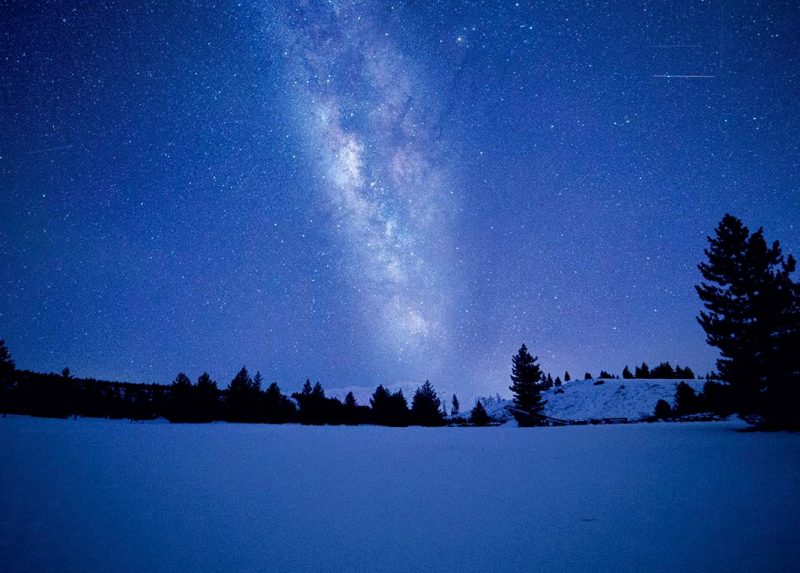
You work out that you are inside it by looking up. Somewhere past Burkes Pass the sky stops being background and becomes the point of the drive, and by the lake the Milky Way is bright enough to throw a faint shadow.
The Lighting Rules Nobody Notices | 没人注意的照明规定
Tekapo at dusk looks slightly underlit, almost sleepy. That is deliberate. Mackenzie District has run lighting controls since 1981, decades before the reserve existed. Outdoor lights must be shielded so the light falls downwards rather than sideways, and the colour kept warm and low.
Ge de qi suo (各得其所) – everything in its proper place – is close to how the ordinance works. Light on the footpath, none in the sky. The petrol station canopy, the school, the streetlights on State Highway 8: all of it points down.
Walk two minutes from the shops towards the lake edge and your eyes adapt properly, because there is nothing bright behind you undoing the work.
Why 700 Metres and Dry Air Matter | 海拔与干燥空气的作用
Rules alone would not be enough. The Mackenzie has geography on its side: the basin sits around 700 metres above sea level, the Southern Alps wring the moisture out of the westerlies before they arrive, and the nearest city glow is well over the horizon.
Dry air scatters less starlight, and altitude means less atmosphere to look through. Astronomers talk about seeing – the steadiness of the air – and the Mackenzie gets more good nights a year than anywhere else in the country.
The honest caveat is that nor-west cloud can shut the basin down for a week. We have driven up from Christchurch (基督城) twice and seen only grey.
Up the Mountain: Mount John and the Guided Tours | 上山:约翰山与观星团
What the Summit Road Feels Like After Dark | 夜色中的山顶公路
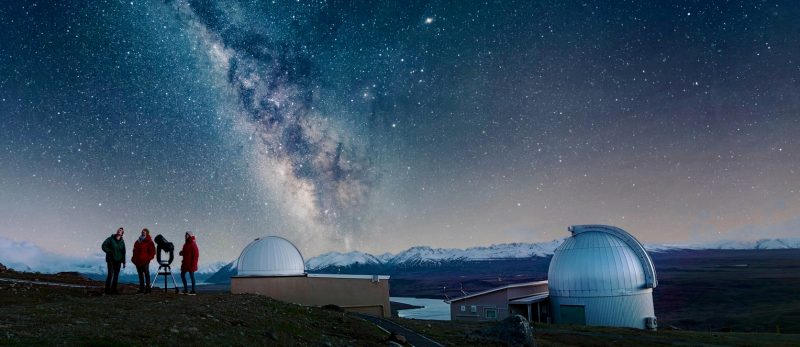
Mount John (约翰山) rises about 300 metres straight off the lake’s southern shore, and the University of Canterbury observatory sits on top of it. The access road is gated at night, which is why the summit is tour-only after dark.
The van climbs in low gear with red film over its headlights, and the guides ask you to put your phone away. That instruction sounds precious until you understand it: full dark adaptation takes about twenty minutes, and one unlocked screen resets everybody near you.
At the top you step out into wind and tussock, the lake a black hole below, and a sky you have never seen from a city.
What You See Through the Telescopes | 望远镜里看到的东西
The telescopes are the part people remember, though not for the reason they expect. Saturn’s rings look faintly fake through a decent instrument, like a sticker on the eyepiece. The Jewel Box cluster near the Southern Cross resolves into blue and red points. Omega Centauri, a globular cluster of ten million stars, hangs there as a grainy ball of light.
Bai wen bu ru yi jian (百闻不如一见) – hearing about it a hundred times is nothing like seeing it once – and this is the moment that earns the phrase.
Between queues the guides run a naked-eye tour with a green laser, often the better half of the night. Expect to share each telescope with twenty people and to be moved along.
Booking, Cost and the Cancellation Problem | 预订、价格与取消
Summit tours run most clear nights and cost roughly $170 to $200 per adult; lakefront and hot-pool sessions are cheaper. Book well ahead for December and January; in June you can often get a seat that week.
The part the brochures skip is cancellation. Cloud kills the tour and the operators make the call a few hours out. If your Tekapo stay is a single night, a cancelled tour is a cancelled experience.
Two nights is the difference between hoping and planning. Sui yu er an (随遇而安) – take the night as it comes – is a useful attitude to pack, along with a refund policy you have actually read.
The Hot Pools Option | 温泉观星
For anyone who cannot face ninety minutes in a Mackenzie wind, Tekapo Springs (特卡波温泉) runs a stargazing session in the hot pools. You float in about 38 degrees of water while a guide talks you through what is overhead, and the contrast between warm shoulders and a freezing face is genuinely pleasant.
It is not the same experience. There is low light around the pools, no telescopes of any real size, and steam drifting across your view.
What you get instead is the sky without the suffering, which for families with small children or older travellers is the version that works. We have done both, and we would take the pools again in July.
Naked-Eye Nights From the Lakefront | 湖畔肉眼观星
Finding the Southern Cross | 如何找到南十字座
You do not need a tour at all. Walk five minutes from the village to the lakefront, turn your back on the few lights there are, and give your eyes a quarter of an hour.
For northern-hemisphere readers the first job is the Southern Cross (南十字座) – four bright stars in a kite shape, smaller than you expect, with the two Pointers trailing behind. Extend the long axis of the kite four and a half times and you are looking at due south. There is no southern pole star doing that work for you, which is half the pleasure.
In winter it sits high and obvious. On spring evenings it hangs low and beginners walk straight past it.
The Magellanic Clouds and the Galactic Core | 麦哲伦云与银河核心
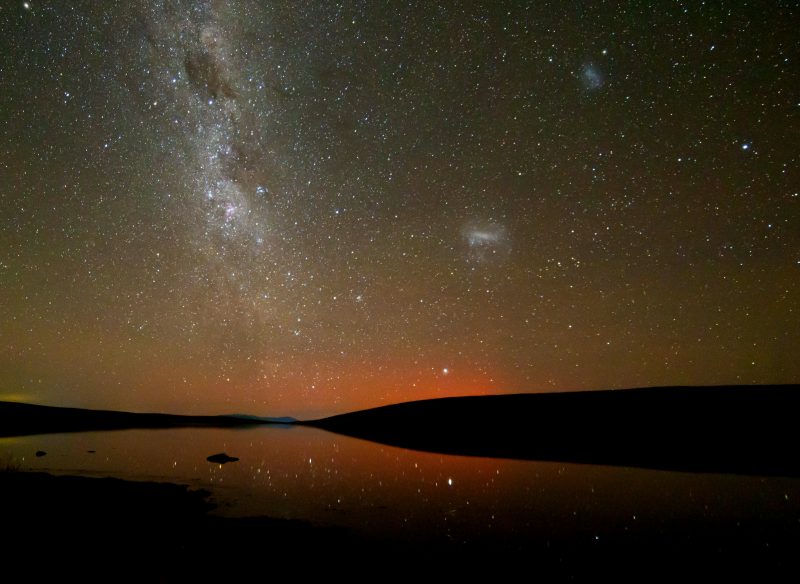
The other thing that stops northern visitors is the pair of smudges off to one side. The Large and Small Magellanic Clouds are dwarf galaxies, 160,000 and 200,000 light years away, and from a truly dark site they look like torn pieces of the Milky Way that drifted off.
First-timers assume they are cloud. They are not; the giveaway is that they do not move.
Yin han can lan (银河灿烂) – the river of silver, ablaze – is what Chinese readers grow up calling the Milky Way, and in a Mackenzie winter the name earns itself. The galactic core rises through the middle of the night in June and July, thick and mottled with dust lanes.
The Church Everyone Photographs | 人人拍照的教堂
The Church of the Good Shepherd (好牧人教堂) sits on the lakeshore, built in 1935 from local stone, and photographed more than any other building in the South Island. At night it is a problem and an opportunity at the same time.
The opportunity is obvious: a stone church silhouetted under the Milky Way is a picture that takes itself.
The problem is everybody else, their torches, and the tripods jammed shoulder to shoulder on a small patch of grass. Access is restricted overnight and signs ask people not to light-paint the stonework. Shoot it early, then walk ten minutes along the shore for the sky itself. The stars do not need the church in front of them.
Getting the Night Right | 把这一夜安排好
Moon Phase Beats the Weather Forecast | 月相比天气预报更重要
Here is the mistake almost everybody makes. They watch the cloud forecast obsessively, book around it, arrive on a clear evening three days off full moon, and see a tenth of what they came for.
A full moon in a dark sky reserve is a floodlight. It washes out the Magellanic Clouds and reduces the Milky Way to a suggestion.
Yue hei feng gao (月黑风高) – a moonless night and a high wind – is a phrase Chinese speakers use for something ominous. For stargazing it is close to ideal. Choose your dates in the week either side of new moon first, then worry about cloud. Moon phase is knowable months out; weather is not.
How Cold It Actually Gets | 到底有多冷
The Mackenzie is a basin, and basins pool cold air. In February – midsummer here – a clear night at the lake can sit at 3 or 4 degrees by 1am, and the wind off the water takes it lower. In July it drops well below zero and frost forms while you stand in it.
We have watched people in shorts and jandals last eleven minutes. Take the same kit in February as in July:
– a merino base layer
– a windproof shell
– gloves and a warm hat
– a red-light torch, not a white one
Shou jiao bing liang (手脚冰凉) – hands and feet gone cold – happens fast when you stand still, staring upwards, for an hour. Standing still is the whole activity.
The Daytime Tekapo You Should Not Skip | 白天的特卡波
Lake Tekapo (特卡波湖) in daylight is a different town, worth the extra morning. The water is an improbable milky turquoise – rock flour ground fine by glaciers and held in suspension – and it shifts with the light rather than sitting there like a postcard.
Shui tian yi se (水天一色) – water and sky the same colour – is not quite right here, because the lake is the more remarkable of the two.
Walk the Mount John summit track in the morning for the view down the basin, swim if you are brave, and eat before 7pm because the village kitchens shut early. The cafes are fine rather than memorable. You came for the lake and the sky.
What stays with you is not the telescope views, impressive as they are. It is the walk back to the car with an aching neck, and the realisation that this is what the sky has always looked like – that most of us have never stood anywhere dark enough to notice. Ye shen ren jing (夜深人静) – deep night, everything still – and above the Mackenzie, anything but empty.