
The Coromandel – Cathedral Cove, Hot Water Beach and the Peninsula
Cathedral Cove access, the Hot Water Beach tide window and the quiet west coast - what twelve years of Coromandel weekends actually taught us.
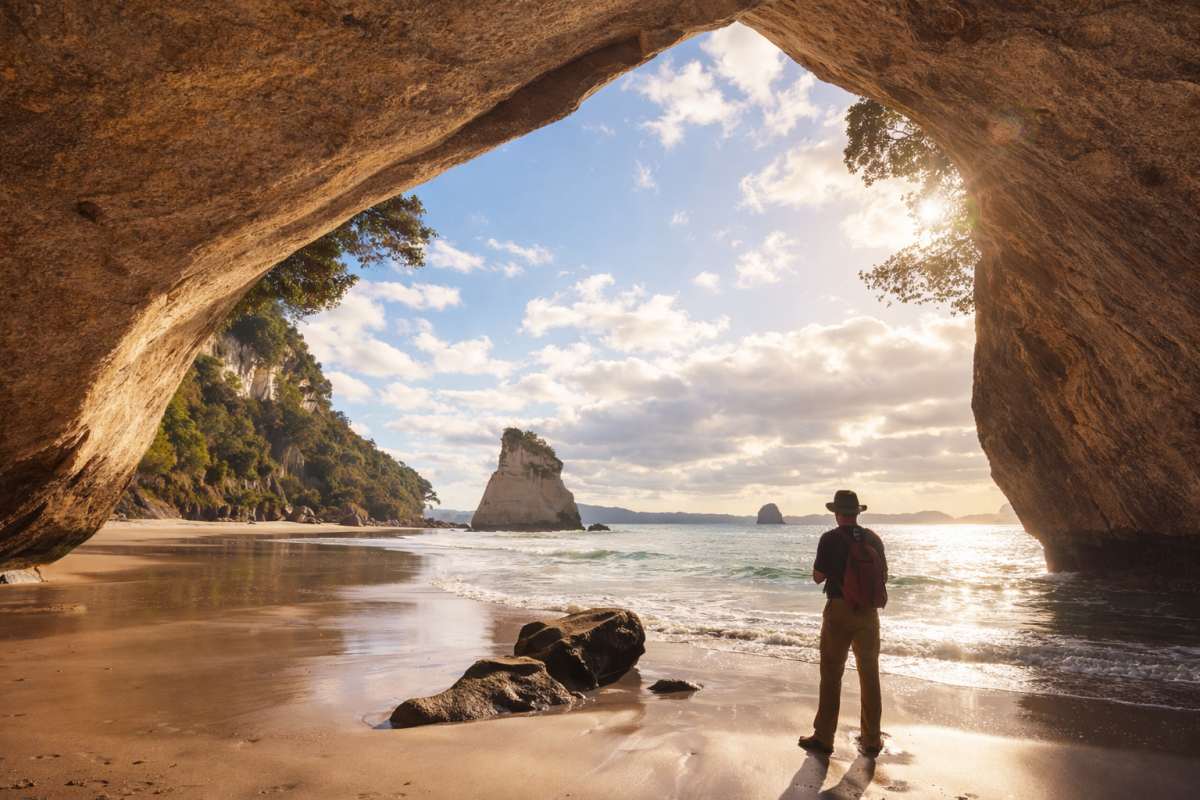
Everyone in Auckland has done the Coromandel, or believes they have: two nights in Hahei, a photograph under the arch, a hole dug at Hot Water Beach, home for Sunday dinner. Zou ma guan hua (走马观花) — looking at flowers from a galloping horse — is what most of those weekends amount to. We have been going back twelve years, mostly in the shoulder seasons, and the peninsula still hands us something we did not expect.
The Weekend Everyone Thinks They Know | 人人自以为熟悉的那个周末
Two Hours on the Map, Three on the Road | 地图上两小时,路上三小时
Google Maps says two hours and fifteen minutes from central Auckland to Whitianga (怀蒂昂格). It has never once taken us that.
The Kopu bridge over the Waihou River is where the trip actually begins, and on the Friday of a long weekend the queue for it starts back near Ngatea. Past Thames the road stops pretending to be a highway. SH25 clings to the coast in tight blind corners, and there is almost always a campervan setting the pace.
Add the Kopu-Hikuai climb over the range, another forty minutes of switchbacks, and a realistic door-to-door figure is three hours. Leave Auckland at lunchtime or after seven at night. The middle window belongs to everyone else.
January, and the Peninsula at Capacity | 一月,半岛人满为患
Between Boxing Day and the end of January the peninsula runs at a capacity it was never built for. Hahei goes from a village of a few hundred to several thousand, the shop runs out of ice by mid-morning, and the Hot Water Beach car park fills before nine.
Ren shan ren hai (人山人海) — mountains of people, seas of people. Accommodation roughly doubles and the good places are gone by September.
If January is your only window, time your days around the crowd: dig at dawn, walk in the last hour of light, eat before six or after eight. Otherwise go in late March. The sea is warmer then than in December, the campgrounds have room, and the cove has stretches of ten minutes with nobody in the frame.
Choosing Where to Sleep | 落脚点怎么选
Where you sleep decides how much of the weekend you spend driving.
– Whitianga, the practical choice: supermarket, doctor, places to eat, and the passenger ferry to Ferry Landing that turns a thirty-minute drive around the harbour into a two-minute crossing.
– Hahei, within walking distance of the cove, though the village is small and the summer rates reflect it.
– Tairua and Pauanui, halfway down the east coast, for people who mainly want a beach and a chip shop.
– Coromandel Town on the west, for the quieter half of the peninsula, an hour and a half from Hot Water Beach on a road that will not be hurried.
We usually split it. Two nights east, one night west, the drive between counted as sightseeing rather than transit.
Cathedral Cove: Access Is the Whole Question | 大教堂湾:怎么去才是关键
The Walking Track, and Why It Keeps Closing | 步道,以及它为何一再关闭
For most of the last decade the default was the clifftop walk from Hahei: forty-five minutes each way, a good deal of stair, sea the whole way. Then the storms of early 2023 took the hillside out from under it in several places, and the track spent years closed while slips were stabilised.
Access has reopened in stages, and shut again more than once when the ground moved. Yi bian zai bian (一变再变) — it changes, and then it changes again. Check the Department of Conservation page for the cove in the week before you travel, not the month before.
The car park at the top of the track is a paid lot with a summer shuttle, not somewhere to count on at ten in the morning.
Arriving by Water | 从海上抵达
The boats have quietly become the main way in. Water taxis run off Hahei Beach through the summer — you wade out, climb aboard, and land on the sand at the cove ten minutes later, usually $30 to $45 return per adult.
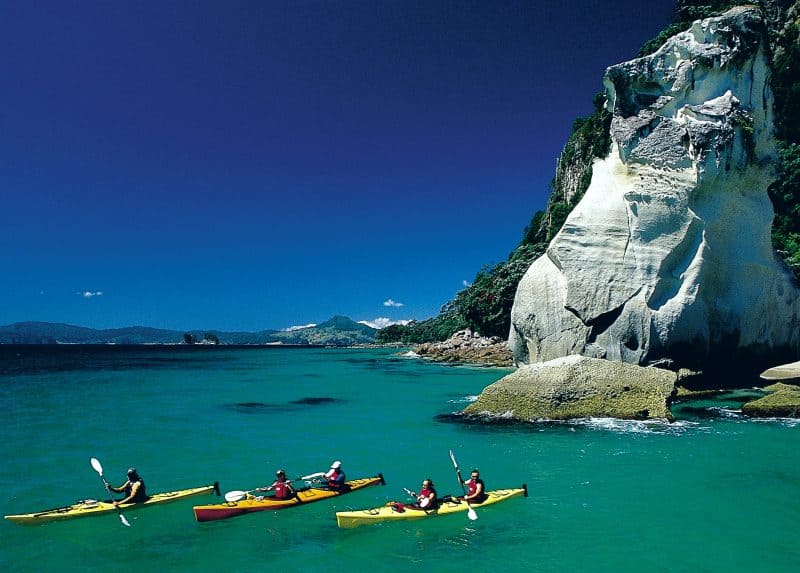
Kayak tours from the same beach take two to three hours and cost closer to $130, but they run you along the base of the cliffs, into Orua Sea Cave and past Te Hoho Rock, none of which the track shows you.
The catch is the sea. An easterly swell shuts the whole operation down, sometimes three days running. Book the first morning of your stay, so a cancellation still leaves a second chance.
What the Cove Is Actually Like | 大教堂湾究竟是什么样
The arch earns its attention. It is a cave cut clean through a headland of white ignimbrite, and standing in the middle with Mare’s Leg Cove on one side and Cathedral Cove on the other, the sound changes — surf noise flattens and comes back at you off the rock. Ling ren zhi xi (令人窒息) — it takes your breath away.
Go near low tide. At high tide the water runs through the passage and crossing is either impossible or a poor idea in a swell.
What the photographs leave out: on a fine January day there can be two hundred people on that sand, three or four drones overhead, and a queue of sorts for the middle of the arch. Nobody has regretted going. Plenty have regretted going at eleven in the morning.
Hahei Beyond the Cove | 哈黑不只有大教堂湾
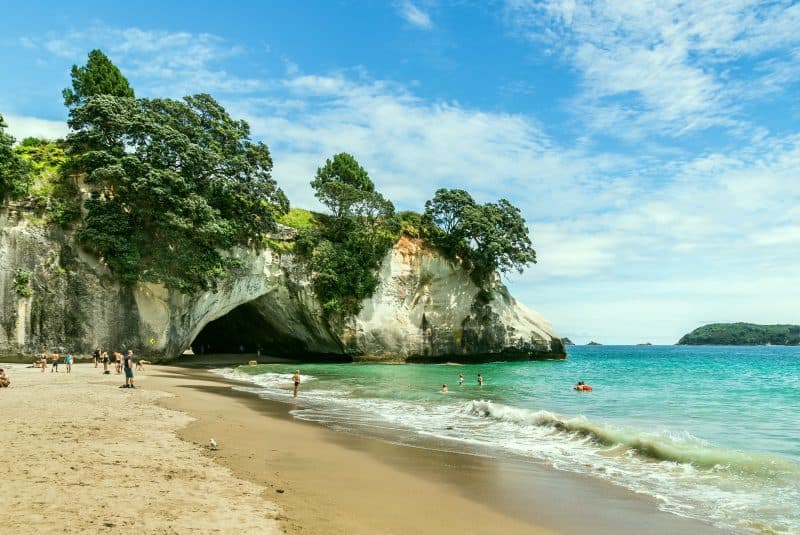
Hahei itself gets treated as a car park with a village attached, which is a waste. The beach is a long curve of sand tinted faintly pink by crushed shell, and it is the better swim: shallower, safer, half empty by four in the afternoon.
At the northern end, Gemstone Bay has a snorkel trail — five marker buoys strung across reef inside Te Whanganui-A-Hei Marine Reserve (海洋保护区), with cards naming what you are looking at.
Visibility is honest rather than tropical, four to six metres on a good day, and you will see snapper, leatherjackets and crayfish under the ledges. Wear a wetsuit even in February. The water sits around eighteen degrees and you will get cold faster than you expect.
Hot Water Beach and the Tide Window | 热水海滩与那个潮汐窗口
Two Hours Either Side, No Negotiating | 低潮前后两小时,没得商量
The thermal water at Hot Water Beach rises through the sand in a patch about the size of a tennis court, and for most of the day that patch is under the sea. You get two hours either side of low tide. That is the whole rule, and it does not negotiate.
Low tide moves roughly fifty minutes later each day, so the window that suited you on Saturday is mid-afternoon by Monday. Check a tide chart for Tairua or Whitianga and treat low tide as the fixed point everything else arranges itself around.
The unglamorous version: we have twice driven over from Coromandel Town, arrived ninety minutes late, and stood watching the sea fill in other people’s holes. Ji suan hao shi jian (计算好时间) — do the arithmetic first.
Digging, Scalding and Sharing | 挖坑、烫脚与共处
Bring a spade or hire one. The shop and the surf club rent them for five to fifteen dollars, and hands do not work.
The hot patch sits in front of the rocks at the southern end and it is not subtle — follow the crowd, or walk barefoot until the sand stops being pleasant. The water comes up at around sixty degrees in places, hot enough to hurt, and the craft is building a seaward wall that lets in just enough cold to make your pool bearable.
Expect company. At peak times there are fifty or sixty holes going and you will be sharing a wall with strangers, which is more sociable than it sounds. Expect also to lose the whole thing to one wave, twenty minutes after you finish it.
The Surf Nobody Warns You About | 没人提醒你的那片浪
Hot Water Beach has a reputation among people who work this coast, and it has nothing to do with the hot water. The beach faces open ocean, the bank drops away fast, and the stretch directly in front of the thermal area is one of the worst places on the peninsula to swim.
It is patrolled over summer, but the flags sit well away from where everyone is digging and plenty of visitors never register the difference. Swim between the flags or swim at Hahei.
The pools need watching too. Sixty-degree water and a five-year-old are a poor combination, and the burns the local clinic treats each summer are almost all feet.
The Quieter Half | 更安静的那一半
309 Road, Kauri and Falls | 309公路、贝壳杉与瀑布
The 309 Road cuts across the spine of the peninsula between Whitianga and Coromandel Town, and it is the best twenty-two kilometres on the Coromandel. Most of it is unsealed — graded gravel, fine in a normal car driven at fifty rather than eighty, though read your rental agreement, because some companies still carry clauses about metal roads.
Stop at Waiau Falls, two minutes from the road, dropping into a pool people swim in. Then stop again at the 309 Kauri Grove: a ten-minute boardwalk into a stand of mature kauri (贝壳杉) the loggers somehow missed.
Scrub your shoes at the station on the way in. Kauri dieback is in this forest and the stations are not decoration.
Coromandel Town at Its Own Speed | 科罗曼德镇的节奏
Over the range the peninsula changes temperature. Coromandel Town has around fifteen hundred people, a main street of wooden verandahs, and none of the east coast’s summer hysteria.
The mussels are why most people stop. The farms are out in the Hauraki Gulf and the steamed pots here are better and cheaper than anything in Auckland. The Driving Creek Railway, a narrow-gauge line a potter built by hand up the hillside over several decades to carry clay, is the sort of project only somebody who stopped counting the years would finish.
Man man lai (慢慢来) — take it slowly — is more or less the town’s operating principle. Be warned that dinner service ends early. We have arrived at seven on a winter evening and found exactly one kitchen open.
The Pinnacles, Overnight | 尖峰山,住一晚
The Pinnacles are the reason to give the peninsula a third day. The track starts in the Kauaeranga Valley behind Thames and climbs the old Webb Creek packhorse route on stone steps the kauri loggers cut a century ago, reaching Pinnacles Hut in about three hours. The steps are relentless, and going up in the wet is genuinely slippery.
The hut sleeps eighty and books out months ahead for summer weekends. The fee is modest, the booking is not optional, and rangers do check.
Go up in the afternoon, eat early, and walk the last forty-five minutes to the summit before dawn. The final section is ladders and rungs bolted into rock. From the top on a clear morning you can see water on both sides of the peninsula at once, and the coast you spent two days queueing on looks like very little at all.
The Coromandel does not reward the itinerary. It rewards the tide chart, the early start, and the willingness to take the gravel road instead of the sealed one. Hou zhi hou jue (后知后觉) — we worked most of this out too late, on trips spent standing on the wrong beach at the wrong hour. Go in March, sleep one night on the west coast, and let the place be slower than the drive over suggested it would be.
4 Comments
Live in Whitianga and the bit about the Kopu bridge on a Friday is painfully accurate. Would add that the queue coming back on the Sunday of Labour Weekend is worse than the queue going over. We just stay put and let it clear.
Thank you for being honest about the tide window. My parents visited from Shanghai last summer and I took them to Hot Water Beach at two in the afternoon with no idea, we stood there for an hour looking at water. Sent them this article for the next trip. The 309 Road section is the part I did not know about at all.
Gemstone Bay is underrated, agreed. Only thing I would push back on is the wetsuit line – late Feb into March I have snorkelled it in boardies plenty of times and been fine. Rest of it is spot on though, especially the rip warning.
Did the Pinnacles in November and those Webb Creek steps nearly finished me. Worth every one of them for the sunrise.