
Hamilton and Waikato – The Heartland Beyond the Caves and Hobbiton
A regional guide to Hamilton, Raglan, Waitomo, and the Waikato heartland -- the river city, surf coast, and farmland between the famous attractions.
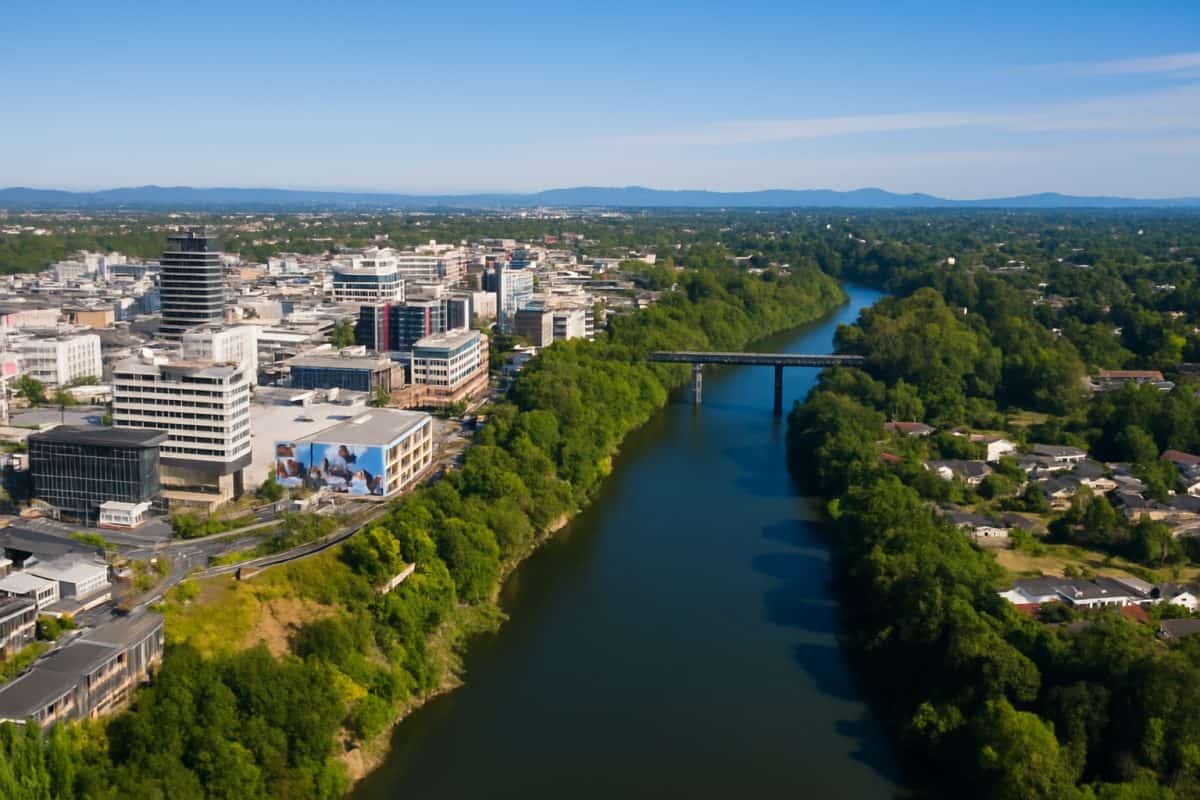
The Waikato does not shout. It sits between Auckland and the central North Island, quietly being one of the most productive and surprisingly varied regions in New Zealand, and most travellers barrel through it on the expressway without a second glance. We did too, for years, until we stopped — first for the caves, then for a garden, then for a surf town that refused to let us leave. The Hamilton and Waikato region is farmland and river city, glowworms and hobbits, black-sand beaches and small towns with excellent pies. It is the heartland, and it rewards anyone willing to get off the highway.
The River City Nobody Rushed To
Hamilton as a Place People Actually Live
Most people encounter Hamilton the same way we did the first time — through a car window, on State Highway 1, heading somewhere else. Auckland to Rotorua. Auckland to Taupo. Auckland to anywhere south. Hamilton sits at the junction of all those journeys, and for years we treated it accordingly: a petrol stop, a bathroom break, a place where the GPS said “turn left.”
That is a mistake, and we are here to say so.
Hamilton is New Zealand’s fourth-largest city, population around 180,000, built on both banks of the Waikato River — the country’s longest. It is a university town with a decent cafe scene, a growing restaurant strip on Victoria Street, and the kind of suburban calm that Auckland residents fantasise about during their morning commute. It does not try to impress you. The Waikato-Tainui iwi have deep ancestral ties to this river and this land, and that history runs beneath the surface of a city that might otherwise read as purely functional. There is something honest about Hamilton. It is not performing for tourists. It is just living its life, and if you slow down enough to notice, that life is more interesting than the highway suggested.
Hamilton Gardens and the Art of Borrowed Landscapes
If Hamilton has one attraction that justifies rearranging your itinerary, it is Hamilton Gardens — and we say this as people who were sceptical about a garden being anyone’s main event. We were wrong. This is not a botanical garden in the conventional sense. It is a collection of enclosed garden “rooms” at Hamilton Gardens, each designed to represent a different historical and cultural approach to garden-making: Italian Renaissance, Japanese, Indian Char Bagh, English Flower, Modernist, and more.
The one that stopped us mid-step was the Chinese Scholar’s Garden (zhongguo wenren yuanlin, 中国文人园林). If you grew up with any exposure to classical Chinese garden design — the moon gates, the rock arrangements, the careful framing of negative space — walking into this enclosure in the middle of the Waikato is a peculiar experience. Familiar and dislocated at the same time. Shu bu shu xi, you bu neng shuo (说不出的熟悉). The detailing is thoughtful, the proportions are right, and on a quiet weekday morning you can have it almost to yourself.
Budget at least two to three hours. The gardens are free, which feels like an administrative error given the quality. Bring lunch — there are lawns between the themed gardens that were made for sitting.
The River Walks and Waikato University
The Waikato River defines Hamilton in a way that is easy to miss if you only see the city from the road. From the river paths, Hamilton becomes a different place entirely. The trails run along both banks, flat and shaded by willows, passing through parks and under bridges. On a Saturday morning you will share the path with joggers, dog walkers, and the occasional rowing eight slicing the brown water into clean lines.
The University of Waikato campus sits on the river’s eastern bank, and the student population gives Hamilton something it would otherwise lack — a reason for good coffee. The stretch of cafes and restaurants along Hood Street and Victoria Street exists largely because twenty-thousand-odd students need somewhere to eat that is not the university cafeteria. We are not complaining.
The river itself is wide and slow through Hamilton, carrying that particular brown-green colour that speaks to the farmland upstream. It is not the Waikato’s most dramatic stretch — that honour belongs to the Huka Falls further south — but it is the stretch that makes you understand why this city is here. Before the highway, before the university, the river was the reason. Waikato-Tainui knew this. The city was built around their knowledge, even if the modern streetscape has mostly forgotten to say so.
The Underground and the Shire
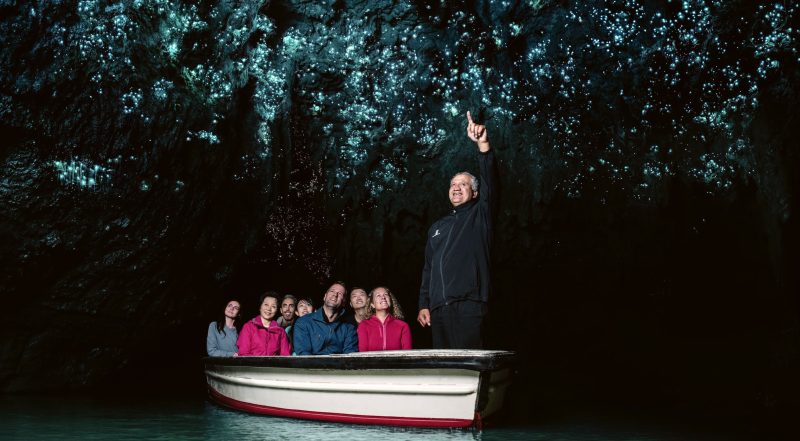
Waitomo Caves and What Thirty Million Years Looks Like
The Waitomo Glowworm Caves sit about an hour south of Hamilton, in limestone country managed by the Department of Conservation where the hills are riddled with passages that have been forming since before humans existed on this planet. Thirty million years of water working through rock. We mention the timescale because it is easy to forget, standing in a gift shop buying your ticket, that what you are about to see is genuinely ancient.
The main cave tour ends with a boat ride through the Glowworm Grotto — a low-ceilinged chamber where thousands of Arachnocampa luminosa larvae hang from the rock, their bioluminescent threads creating a blue-green galaxy overhead. The guide asks everyone to stay silent. For once, everyone does. It is one of those rare tourist experiences that delivers exactly what the brochure promises, possibly more, because no photograph captures the scale of the darkness or the way the light reflects off still water.
Waitomo gets busy — Chinese tour groups have had this on the circuit for years, and the main cave can feel crowded at peak times. If the crowds bother you, book the Ruakuri Cave tour instead: longer, fewer people, and the formations are arguably more impressive. The Aranui Cave is the driest and most delicately decorated of the three. All are worth seeing if you have the time.
Hobbiton and the Matamata Farmland
Hobbiton is a forty-five-minute drive east of Hamilton, on a private farm outside Matamata that Peter Jackson chose because the rolling green hills looked exactly like what Tolkien described. He was not wrong. The landscape around Matamata is so perfectly pastoral — so aggressively, impossibly green — that it barely needs the hobbit holes to feel fictional.
We will be honest: Hobbiton is a commercial film tourism operation, and it is priced accordingly. The tours are timed, the paths are managed, and you will share the experience with several dozen other visitors. But it is also, undeniably, beautifully done. The attention to detail in the hobbit holes — the tiny washing lines, the miniature gardens, the round doors painted in specific colours — is the work of people who understood that the joy of this place is in the small things. The garden at Bag End alone took years to establish.
What we did not expect was how affecting it would be to stand in a place that exists only because someone imagined it. Tolkien never saw Matamata. Jackson saw a farm and recognised a story. And now thousands of people a year walk through that story as if it were real, which, in a way it has become. Xu gou bian cheng le xian shi (虚构变成了现实) — fiction became real. The surrounding farmland, incidentally, remains a working dairy operation. The cows are unimpressed by all of it.
Beyond the Two Big Names
Waitomo and Hobbiton dominate the Waikato’s tourist trail, which means everything else gets overlooked. This is your gain if you are the sort of traveller who likes having a place to yourself.
Te Aroha, at the base of the Kaimai Range, has a natural hot soda spring that is genuinely rare — one of only two such springs in the world. The restored Edwardian bathhouse in the town’s domain is worth a visit even if you do not plan to soak. For walking, the Karangahake Gorge between Paeroa and Waihi threads through old gold-mining country: railway tunnels carved through rock, suspension bridges over the Ohinemuri River, and a mining history that is equal parts enterprising and brutal.
Back in Hamilton, the Waikato Museum on the river’s edge houses a collection that is stronger than you would expect from a regional museum — significant Tainui taonga, a solid natural history wing, and rotating exhibitions that occasionally surprise. It is free, air-conditioned, and a reliable option for a rainy afternoon.
These places do not make the postcards. They are the rewards for staying longer than a day trip, for treating the Waikato as a region rather than a route between two attractions.
Raglan and the Coast That Faces West
A Surf Town That Stayed Small
Raglan sits forty-five minutes west of Hamilton, where the Waikato’s dairy plains give way to bush-clad hills and then, suddenly, the Tasman Sea. It is a surf town that has managed, against all the pressures of the last two decades, to stay small. One main street. A harbour. Cafes with surfboards propped outside. The population hovers around three thousand, and the locals seem determined to keep it that way.
The surfing here is serious. Manu Bay offers one of the longest left-hand point breaks in the world, and Whale Bay next door is nearly as good. But Raglan’s appeal extends well beyond the lineup. This is a town where the pace drops the moment you arrive, where people say hello to strangers, and where the evening agenda is to find a spot facing west and wait for the sky to do its thing.
We first visited Raglan on a day trip from Hamilton, expecting a pleasant beach town. We stayed until dark, drove back talking about when we could come back, and returned the following weekend. That pattern — meaning to visit once and then returning repeatedly — seems to be the standard Raglan experience. The town has a gravitational pull that is difficult to explain and impossible to resist. Ni qu le jiu bu xiang zou (你去了就不想走).
Black Sand and the Waikato Sunsets
The beaches around Raglan are not the golden-sand, turquoise-water variety that tourism brochures prefer. They are west coast beaches, which in New Zealand means something specific: dark volcanic sand that absorbs heat, heavy waves rolling in from the Tasman, and weather that can shift from blue sky to horizontal rain in the time it takes to eat a sandwich.
Ngarunui Beach is the main swimming beach, patrolled in summer, with the kind of open-sky scale that makes you feel appropriately small. The sand is iron-black and fine, and on a hot day it will burn your feet if you stand still. The waves are substantial even on calm days — this is not a paddling beach. It is a beach for people who like their ocean with some authority.
But the real reason to be on these beaches is the sunset. The west coast faces directly into the evening sun, and on a clear day the sky cycles through colours that feel frankly unreasonable — amber, rose, copper, deep violet, and a final band of green that sits on the horizon for exactly one breath before the light goes. We have watched sunsets in a lot of places. The Raglan coast, on its day, is as good as any of them. Mei ci de luori dou bu yi yang (每次的落日都不一样) — every sunset is different.
Eating and Drinking in Raglan
For a town of three thousand people, Raglan has no business having a food scene this good. And yet.
The cafes here lean organic, locally sourced, and unapologetically artisanal. You will find menus that feature both an excellent flat white and a turmeric-oat-milk something, and the remarkable thing is that both are made with genuine care. The baking is consistently good — the kind of banana bread and cheese scones that people drive from Hamilton to buy, which tells you everything about priorities in this part of the world.
Fish and chips is a matter of local debate. Raglan takes its fish and chips seriously, and asking which shop is best is a reliable way to start a twenty-minute conversation with anyone in town. We have our opinion. We are not sharing it here because we want to visit again without being argued with.
The Raglan food experience is not about fine dining. It is about the pleasure of eating well in a small place that cares about what it serves. A toasted sandwich on the harbour. A wood-fired pizza after a surf. Fresh fish from the wharf, cooked simply, eaten while the sun goes down. If you grew up eating well — and if you are reading this site, there is a reasonable chance your family has opinions about food (chi huo de jiating, 吃货的家庭) — you will recognise the attention to quality here, even in its most casual form.
The Heartland Itself
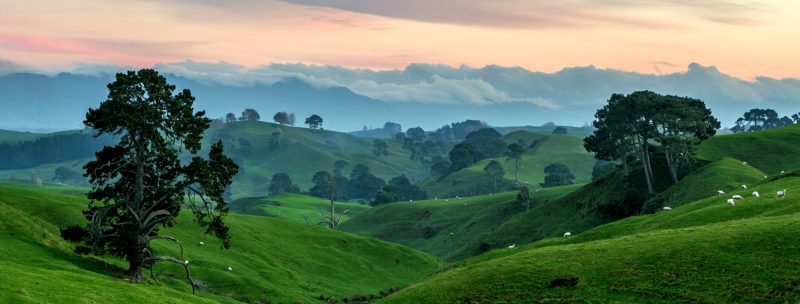
Dairy Country and the Green That Never Stops
Drive fifteen minutes in any direction from Hamilton and you are in dairy country. The Waikato is New Zealand’s most productive agricultural region, and the landscape announces this with a green so vivid it looks artificially enhanced. It is not. That is just what happens when you combine volcanic soil, reliable rainfall, and several million cows.
The farmland rolls in every direction — gentle hills divided by fence lines, punctuated by stands of native bush that survived the clearing, dotted with the white-wrapped silage bales that look like enormous marshmallows abandoned in paddocks. In spring, the green intensifies to a shade that does not exist in urban colour palettes. In winter, the fog sits in the valleys until mid-morning, and the hills emerge from it like islands.
For those of us who grew up in Chinese cities — in the density of Guangzhou or Shanghai or Beijing — the Waikato’s emptiness is its most striking quality. You can stand on a hill and see twenty kilometres of farmland without a single building taller than a barn. Lv se yi zhi dao tian ji xian (绿色一直到天际线) — green all the way to the horizon. It takes a while to adjust to that much space. Some of us are still adjusting, a decade on.
Small Towns and the Service Centre Rhythm
The Waikato’s small towns follow a pattern you learn to read quickly: one main street, a Four Square or dairy on the corner, a pub that has been there since the 1920s, a war memorial listing names from both World Wars, and a takeaway shop that closes at eight. These are service towns for the farming community — Te Awamutu, Morrinsville, Matamata outside of Hobbiton — and they do not pretend to be anything else.
Cambridge is the exception, and it knows it. Sitting on the Waikato River twenty minutes south-east of Hamilton, Cambridge has a tree-lined main street, antique shops, art galleries, and an equestrian culture that gives the whole town a faintly English atmosphere. The horse studs surrounding Cambridge produce thoroughbreds that race internationally, and the town carries that association with visible pride. It is the kind of place where you might stop for coffee and accidentally spend an afternoon browsing.
The other small towns reward a different kind of visit — the kind where you are not looking for attractions, just looking. Te Awamutu’s rose gardens. Morrinsville’s dairy-themed public art. The way every small-town bakery in the Waikato sells a mince and cheese pie that tastes exactly the same and is exactly what you want at ten in the morning after an early start.
How to Approach the Waikato
The Waikato works best as a two-to-three-day loop based out of Hamilton, with day trips radiating in each direction. Hamilton to Raglan is forty-five minutes west. Hamilton to Waitomo is an hour south. Hamilton to Hobbiton is forty-five minutes east. Hamilton to Cambridge is twenty minutes south-east. You can see the marquee attractions in day trips and still have time to walk the river, eat well, and discover the places that nobody told you about.
Hamilton itself has the widest range of accommodation — from budget motels on Ulster Street to decent hotels near the city centre. Raglan has the character stays: surf lodges, boutique B&Bs, and a holiday park right on the harbour. For families, the Raglan holiday park is difficult to beat.
The Waikato is green year-round, but summer and autumn (December through May) are the best seasons for Raglan’s beaches and the outdoor attractions. Winter brings fog to the plains and rain to the coast, which has its own moody appeal if you are not counting on sunshine.
The honest pitch for the Waikato is this: it is not a highlight. It is a region. The difference matters. Highlights are things you tick off — cave, movie set, done. A region is something you settle into, and the Waikato rewards settling. Man man lai (慢慢来) — take it slowly. The heartland is patient, and so should you be.
The Waikato is the kind of region that grows on you. Not because it tries to impress — it does the opposite — but because it offers something increasingly rare in a country that markets itself on spectacle: ordinariness done well. The river walks, the green hills, the small-town bakeries, the sunset over Raglan. None of it is trying to be a highlight reel. All of it, taken together, is the texture of a country that is worth knowing slowly. Zhe shi xinxilan zui zhen shi de yangzi (这是新西兰最真实的样子) — this is what New Zealand really looks like.
3 Comments
Ha, the fish and chips diplomacy in Raglan is real. You are smart not to pick a side. I will say that the wood fired pizza place is worth the trip on its own though. We drive down from Hamilton most weekends in summer just for that and the sunset. The Ngarunui Beach description is perfect — “ocean with some authority” is exactly right.
Glad you gave Hamilton a fair go. Born and raised here and it always stings a bit when people treat it as a pit stop. The river walks are underrated for sure. Only thing I would add is the Waikato-Tainui connection deserves more than a mention in passing — the river is taonga to us, it is the reason our people are here. The Hamilton Gardens piece on the Maori garden is worth checking out too if you have not been.
The Chinese Scholar Garden at Hamilton Gardens caught me completely off guard. I dragged my husband there expecting it to be a token effort and ended up standing in the moon gate for ages just… feeling homesick? In a good way? The proportions really are right, you can tell whoever designed it understood the principles. My parents visited from Hangzhou last year and even they were impressed, which trust me is not easy to achieve with classical garden design.