Skydiving Over Lake Taupo – Freefall Above the Central Plateau
First-hand account of tandem skydiving over Lake Taupo from 15,000 feet -- the jump, the volcanoes, the price, and whether it is worth every dollar.
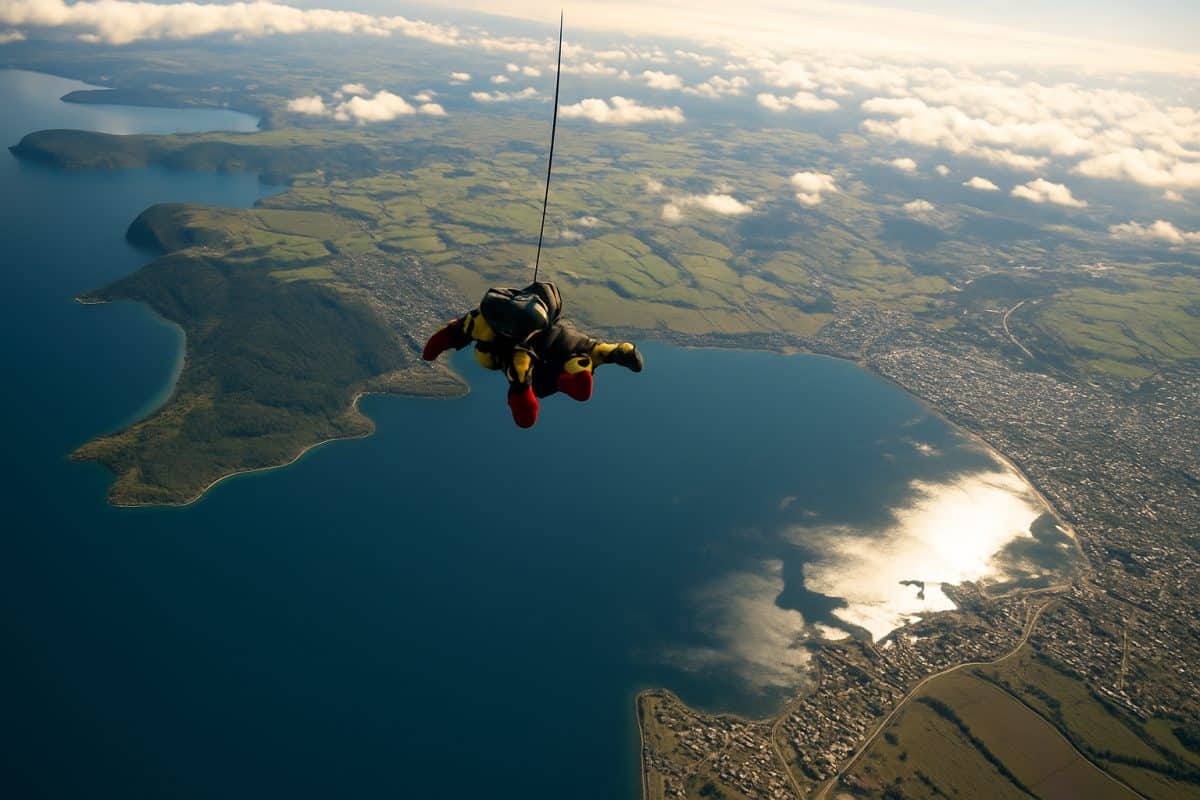
We had talked about it for three years before we actually did it. Skydiving over Lake Taupo — the one activity on every New Zealand adventure list that makes your palms sweat just reading about it. On a Tuesday morning in February, we drove to the dropzone, signed forms we tried not to read too carefully, and stepped out of a plane at 15,000 feet above the largest lake in the country. The sixty seconds that followed are the hardest thing we have ever tried to put into words.
Getting Yourself to the Edge
Why Taupo and Not Somewhere Else
New Zealand has half a dozen commercial skydiving operations, and you could jump over the Remarkables in Queenstown or the Abel Tasman coastline near Motueka. Both are spectacular in their own way. But Taupo is where most people jump for the first time, and after doing it ourselves, we understand why. It comes down to what sits beneath you.
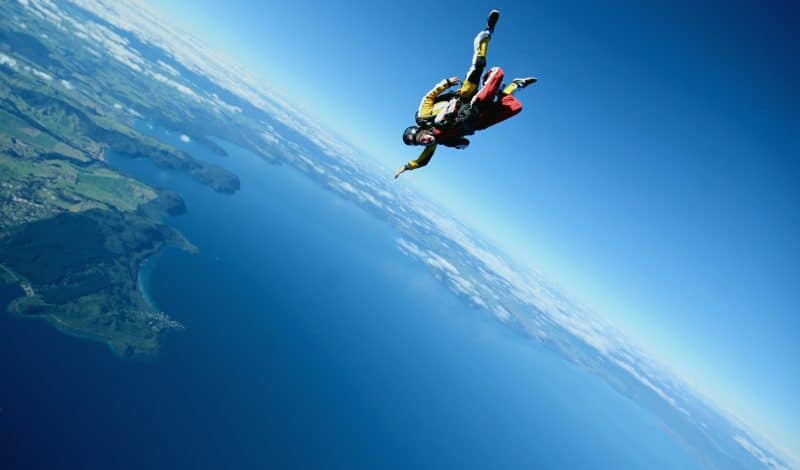
From 15,000 feet above Taupo, you are looking at the largest lake in New Zealand spread out like a blue lens set into the plateau. South of the lake, the volcanic cones of Ruapehu, Ngauruhoe, and Tongariro stand along the horizon in a line that looks designed rather than geological. The farmland between lake and mountains is so green and so flat that it reads as texture rather than landscape. On a clear day — and Taupo gets more clear days than it has any right to — you can see from the Kaimanawa Ranges to the distant shimmer of the Hauraki Plains. Skydive Taupo, the main operator, has been throwing people out of planes over this view since 1992. They know the airspace, they know the winds, and they know exactly which flight path gives you the best angle on the volcanoes. The other dropzones offer excellent jumps. Taupo offers a panorama.
Booking, Showing Up, and the Wait
You can book online and we would strongly recommend it, especially between November and March when Taupo fills with summer visitors and backpackers ticking off bucket lists. Walk-ins are possible on quieter days but you risk sitting around for hours or being told to come back tomorrow. Altitude options typically run at 12,000 feet, 15,000 feet, and 18,500 feet. The price difference between the lowest and highest is significant — roughly one hundred dollars separates the cheapest jump from the most expensive — and so is the experience. We went with 15,000 feet, which gives you about sixty seconds of freefall. The 18,500-foot option stretches that to seventy-five seconds and adds a genuine edge-of-the-atmosphere feeling, but it costs more and is weather-dependent.
When you arrive at the dropzone on Anzac Memorial Drive, the process starts with a weigh-in that nobody enjoys but everyone endures. Then a safety briefing video, a waiver form that cheerfully lists everything that could go wrong, and the wait. The wait is the worst part. You are sitting in a hangar with other jumpers — some calm, some visibly regretting their decisions, one person in every group cracking jokes that are slightly too loud. Nervous energy fills the space like static. You watch the plane take off with the group before you and disappear into the sky, and you know you are next. We sat there for about forty minutes, which felt like four hours.
The Plane Ride That Changes Your Mind Three Times
The aircraft is smaller than you expect. You sit on a bench along the fuselage with your tandem instructor already clipped to your harness, and there is no pretending you are on a sightseeing flight. Everyone in that plane is going out the door. As the plane climbs, Taupo shrinks. The town becomes a cluster of rooftops at the north end of the lake, the geothermal steam plumes near Wairakei become white smudges, and the lake itself keeps getting wider until it fills the window.
At about 10,000 feet, the instructor checks your harness for the third time and tightens the straps until breathing becomes a negotiation. You appreciate this later. Around 12,000 feet, the jumpmaster slides the door open and wind hits the cabin like a wall. The noise is extraordinary — not a whistle but a roar, as if the sky itself objects to the hole in its side. Cold air floods in and your body temperature drops within seconds even in summer. At 15,000 feet, the first pair shuffles to the edge and then they are gone. Just gone. You did not see them fall — they were there and then they were not. Your instructor taps your shoulder. Your legs are over the edge. Below you is the lake, impossibly blue, impossibly far down, and every rational thought in your head is saying the same thing. Then you tip forward and rational thought stops being relevant.
Sixty Seconds That Rearrange Your Priorities
Freefall Over the Lake
You do not fall. That is the first lie your brain tells — that this is falling. What happens is the air catches you. Two hundred kilometres per hour of wind pins your arms back and presses against your face so hard that smiling becomes a physical effort and not smiling is impossible. The noise is a freight train. Your eyes water. Your cheeks ripple. For the first two or three seconds your brain simply stalls, unable to reconcile the information it is receiving with any previous experience. Then it catches up, and what replaces the panic is something harder to describe — a wide, stupid, overwhelming clarity. You are falling towards Lake Taupo at terminal velocity and there is nothing to do about it except look.
And you look. The lake below is so large it curves at the edges. The three volcanic cones — Ruapehu with its snow cap, the perfect geometry of Ngauruhoe, the low sprawl of Tongariro and its Red Crater — stand along the southern skyline like something from a different planet. Farmland stretches east in squares of green and brown. The Waikato River threads away north like a blue vein. Sixty seconds of this. Your tandem instructor taps your arms into position, gives a thumbs up to the camera if you paid for one, and manages all the technical business while you manage the business of being alive at 200 kilometres per hour with nothing beneath you but geography.
Under Canopy — When the World Comes Back
The parachute opens and the world changes completely. One moment you are in a roar of wind and speed, the next you are floating in silence so sudden it feels like someone pressed mute on reality. Your ears ring. Your heart is pounding in places you did not know hearts could pound. And then you notice the view.
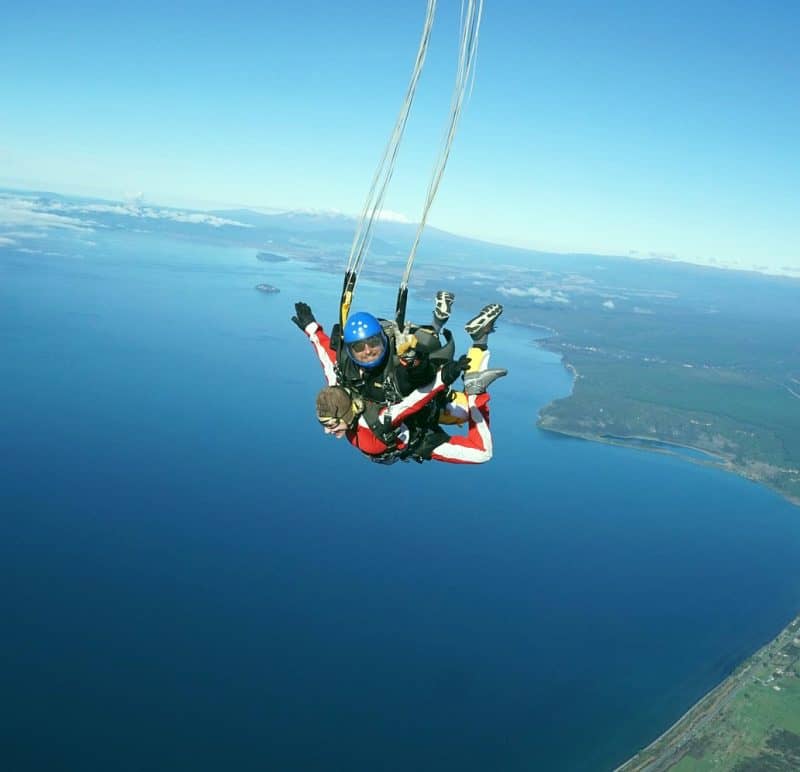
During freefall you see the panorama but you do not absorb it. Under canopy, you absorb it. The lake spreads below like stained glass — that particular Taupo blue that photographs never quite capture, somewhere between cobalt and turquoise depending on the light and the depth. Tongariro National Park occupies the entire southern horizon, every ridge and gully visible in a way that makes topographic maps suddenly make sense. The patchwork of Waikato farmland below is so orderly it looks quilted. Your instructor might offer you the steering toggles, and pulling left sends you into a gentle spiral that tests whether your stomach has anything left to contribute. The descent takes five to seven minutes, which is enough time to think about what just happened and not nearly enough to finish thinking about it. The landing field appears, the instructor talks you through the approach — legs up, lean back — and you slide onto the grass like an answer to a question you did not know you were asking.
Back on the Ground and Thinking Straight
Is It Worth the Money
A 15,000-foot tandem jump with Skydive Taupo costs in the range of four hundred dollars. Photo and video packages — and there are several tiers, from a few still photos to a full cinematic edit — add another hundred to two hundred on top of that. For the complete experience with footage, you are looking at five to six hundred dollars. That is not a casual afternoon expense.
Here is our honest assessment: it is worth it, but not because it is good value per minute. If you break it down by time in the air, you are paying several dollars per second of freefall, which is absurd by any rational measure. You pay because it is an experience that rewires something. We came down different people than we went up. The video package is worth considering seriously — your brain during freefall is too overloaded to form reliable memories, and the footage captures a version of the experience your memory cannot. We sent the video to family back in China and the reactions alone were worth the extra cost. Our mother called three times to confirm we were still alive.
Compared to other Taupo adventure activities, skydiving sits at the premium end. A jet boat ride on the Waikato runs around a hundred dollars, bungy at the nearby operations is roughly similar. Parasailing over the lake costs less than half a tandem jump. None of them come close to the same experience. This is not a comparison of activities — it is a different category entirely.
What We Wish We Had Known
Wear shoes that tie on firmly. Sandals, jandals, slip-ons — anything that relies on friction rather than laces to stay on your feet is a liability at 200 kilometres per hour. We saw a pair of sneakers come off someone during a jump and they were never seen again. Dress in layers. It might be twenty-five degrees on the ground in Taupo, but at 15,000 feet the temperature drops well below zero, and the windchill during freefall makes it colder again. The jumpsuit they give you helps but is not a substitute for a decent base layer.
Eat something light an hour or two before your jump — an empty stomach makes the nerves worse, and a full one makes everything else worse. Book the morning slot if you have a choice. The light is better for photos, the winds are typically calmer, and there is less chance of weather delays pushing your jump to the next day. Speaking of weather: Taupo skydiving is weather-dependent and cancellations happen. If your jump is scrubbed for wind or cloud, the reschedule is free, but you need flexibility in your itinerary. Do not book a skydive for your last day in town with a flight out that evening. Weight limits apply — usually around 100 to 110 kilograms. If you are close to the limit, call ahead rather than discovering the issue at the weigh-in. And skip the beers the night before. Between the altitude, the adrenaline, and the spinning under canopy, a hangover multiplies every unpleasant sensation available to you.
Taupo Beyond the Jump
You will land buzzing. Adrenaline does not switch off neatly, and for the next hour or two you will want to walk, talk, eat, and do everything slightly too fast. Taupo is a good town for this. The lakefront walk runs from the boat harbour along the shore, and the combination of flat ground and water views is exactly what your nervous system needs. If your legs want more than a stroll, the walk to Huka Falls from the Spa Park end takes about an hour through native bush along the Waikato River and delivers you to one of the most photographed waterfalls in the country.
For the opposite of adrenaline, the hot pools at Taupo DeBretts are a ten-minute drive from the dropzone. Or if you prefer free and less manicured, the hot stream at Spa Thermal Park flows into the Waikato River and you can find your own temperature by choosing how close to the source you sit. The Mine Bay Maori Rock Carvings — a set of carvings on the cliff face at the western end of the lake, accessible by boat or kayak — are worth the trip if you have the afternoon. They are contemporary rather than ancient, carved in the 1970s, but they are striking from the water and the boat ride gives you a completely different perspective on the lake you just fell towards. Taupo is a town that understands it exists for visitors, and it fills the gaps between headline activities with enough to keep you occupied without trying too hard.
The drive back to our motel was quiet in a way that had nothing to do with tiredness. Someone said “we actually did that” and nobody needed to respond because we were all still doing it — still falling, still looking at the lake, still trying to understand how a minute can feel longer than the entire morning that came before it. Taupo is a town with a lot of activities and a lot of ways to spend money. This is the one that stays.
3 Comments
Did mine at 15,000 feet last March and can confirm — the bit about your brain stalling for the first few seconds is spot on. I remember looking down at the lake and my eyes could see it but nothing was registering. Then suddenly everything snaps into focus and you just… laugh. Could not stop laughing the whole way down. Also seconding the morning slot tip, we went at 8am and the light on the volcanoes was unreal.
The part about sending the video to family back home really got me haha. I sent mine to my parents in Osaka and my dad watched it on repeat for a week. My mum refused to watch it at all. Five hundred dollars is a lot but honestly I have spent more on things I remember less.
Has anyone actually done the 18,500 foot option? Reckon the extra 15 seconds of freefall is worth the price bump or nah?