
Sheepworld Warkworth – Farm Shows and Shearing an Hour North of Auckland
Sheep shearing, working dogs, and lamb feeding at Sheepworld near Warkworth. An honest guide from Chinese New Zealanders who grew up without farms.
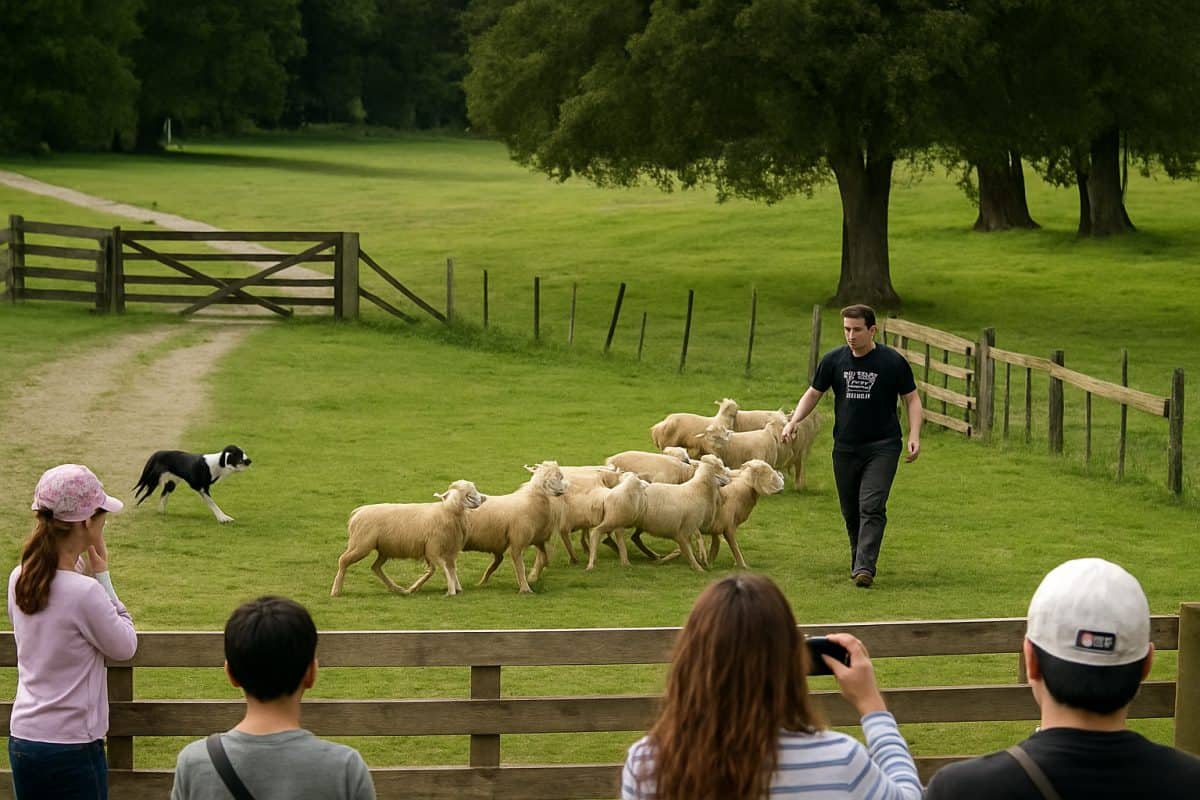
We did not grow up with sheep. Nobody in our families sheared anything, herded anything, or owned anything that produced wool. The closest most of us came to a farm animal before moving to New Zealand was a photograph in a primary school textbook. So when someone suggested stopping at Sheepworld on the way to the Bay of Islands — a roadside farm attraction promising shearing shows and lamb feeding — we were not sure what to expect. What we found was an hour and a half of genuine surprise: a farmer peeling wool off a sheep like he was unwrapping a gift, dogs that understood whistled instructions better than we understood spoken English in our first year here, and the discovery that holding a bottle for a hungry lamb is one of the most disarming experiences available on State Highway 1.
Getting There and What You Are Walking Into
The Drive Up From Auckland
The motorway out of Auckland ends and the road narrows somewhere around Puhoi, and that transition is the real beginning of the trip. One minute you are in six lanes of traffic with a Countdown on every corner, and the next you are on a two-lane highway winding through green hills with cattle standing in paddocks like they own the place. Which, in a sense, they do.
From central Auckland, Sheepworld is about an hour north on State Highway 1 — closer to fifty minutes if you leave early on a Saturday, closer to ninety if you leave after lunch on a Friday. The route takes you through the Johnstone Hills and past the Puhoi Pub, and by the time you reach the outskirts of Warkworth the landscape has shifted from city fringe to proper countryside. Sheepworld sits on the left side of the highway just before you reach the Warkworth township itself. There is a sign, but it is not enormous — if you are deep in conversation or changing the music, you can overshoot. We have done this. The U-turn is not difficult, but it is mildly embarrassing.
For anyone heading further north to the Bay of Islands or Whangarei, Sheepworld is the last easy stop before the road commits to being rural for a very long time.
First Impressions at the Gate
The car park is gravel, the entrance building is low and practical, and there are sheep visible from the moment you step out of the vehicle. This is not a theme park with a grand entrance arch and a turnstile queue. It is a farm that has made room for visitors, and the difference matters.
For those of us who grew up in Chinese cities — apartments stacked twenty storeys high, convenience stores on every block, the nearest livestock a photograph in a textbook — the first sensation at Sheepworld is the smell. Grass, wool, something warm and organic that you cannot quite name. It is not unpleasant. It is just profoundly unfamiliar if your baseline is Shenzhen or Hangzhou. The second sensation is the quiet. No traffic drone, no construction percussion, just wind and the occasional complaint from a sheep who has opinions about something.
Inside, you pay the entry fee, collect a map, and orient yourself. The property is not large — you can see most of it from the entrance — but it is laid out so that different activities happen in different zones. The shows have a covered arena. The animals have their paddocks. The cafe has its corner. It is all very New Zealand: functional, unpretentious, and slightly in need of a paint job.
Timing Your Visit Around the Show Schedule
This is the single most important piece of practical advice we can give you about Sheepworld: check the show times before you drive up, and plan your arrival around them. The farm shows run at scheduled times during the day, and they are the reason to visit. Without the shows, Sheepworld is a pleasant paddock with some animals in it. With the shows, it is an hour and a half of genuine entertainment and education that will make you understand why New Zealand has sixty million sheep and five million people.
Show times vary between summer and winter, and they have changed over the years, so check the Sheepworld website or call ahead on the day. As a general pattern, there are usually one or two shows per day, running about an hour each. The shows combine sheep shearing, sheepdog work, and farm animal interaction into a single programme that flows from one act to the next.
Our advice: arrive fifteen to twenty minutes before the show starts. The arena has open seating, and while it rarely fills completely, the front rows give you a better view of the shearing and let the children reach the lambs more easily during the hands-on sections. If you arrive between shows, walk the grounds, have a coffee, and wait. The show is worth the wait.
The Shows That Make It Worth the Stop
Sheep Shearing Up Close
The shearing demonstration is the centrepiece of Sheepworld, and it is the thing that makes people who grew up in cities sit forward in their seats with their mouths slightly open. A farmer brings out a full-woolled sheep — an animal that looks roughly spherical, like a cloud with legs — positions it between his knees, and proceeds to remove the entire fleece in a single continuous piece. The whole process takes about three minutes. The sheep, once freed from its wool, stands up looking like a completely different animal: lean, pale, and mildly indignant.
The shearing is done with electric handpieces, and the skill is in the handling as much as the cutting. The shearer works in long, confident strokes, keeping the sheep calm by controlling its body position. There is a technique to it that looks effortless and is anything but. In New Zealand, competitive shearing is a genuine sport — there are national championships, world records, and shearers who can do a full fleece in under a minute. The Sheepworld demonstration is not a speed trial, but the competence is obvious.
For our group — mostly from Sichuan and Guangdong — the shearing was the moment the penny dropped. Yang mao, we kept saying to each other. Wool. We had worn wool jumpers our entire lives without once connecting the material to the process. Three minutes of watching a farmer shear a sheep closed a gap in understanding that years of living in New Zealand had not.
Working Dogs and the Art of the Whistle
The sheepdog demonstration is the part that sneaks up on you. You think you know what is coming — a dog chases some sheep around a field, everybody claps — and then you watch a farmer give a sequence of whistles and a dog you had assumed was just sitting there quietly launches across a hillside with surgical precision, cuts off three sheep from a group of twenty, and drives them through a gate from fifty metres away. The dog does not bark. The sheep do not panic. It is like watching someone play chess, except the chess pieces have hooves and the player has four legs.
In Chinese culture, dogs occupy a particular space — they are companions, guards, family members in the urban sense. The idea of a dog as a professional colleague with a skill set and a work ethic is genuinely new to most Chinese visitors, and the Sheepworld show makes this visible in a way that talking about it never could. The farmer explains the commands — different whistles for left, right, stop, come — and the dog responds to each one with an attentiveness that borders on telepathy.
Children love the dog show because the dogs are beautiful and fast. Adults love it because it reveals something about rural New Zealand that you cannot learn from a guidebook: the working relationship between farmers and their animals is old, skilled, and quietly extraordinary.
Feeding Lambs and Meeting the Rest
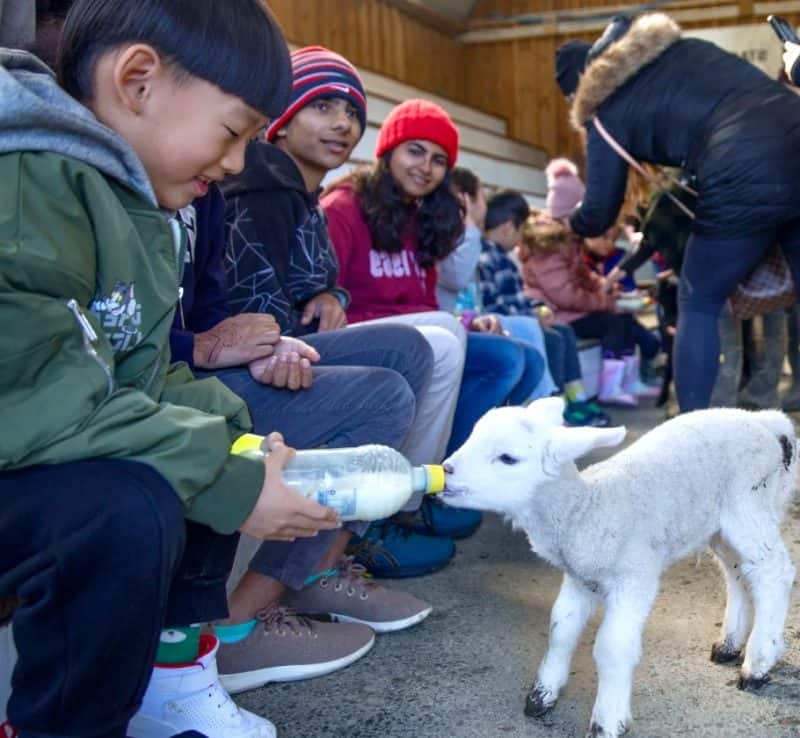
After the shearing and the dogs, there is the part where you get to touch the animals, and this is where the adults suddenly become children again. Bottle-feeding lambs is the headline act — you hold a bottle, a lamb latches on with more force than you expected, and for thirty seconds you are responsible for a small woolly animal that is looking at you with an expression somewhere between trust and hunger. It is absurd and it is lovely.
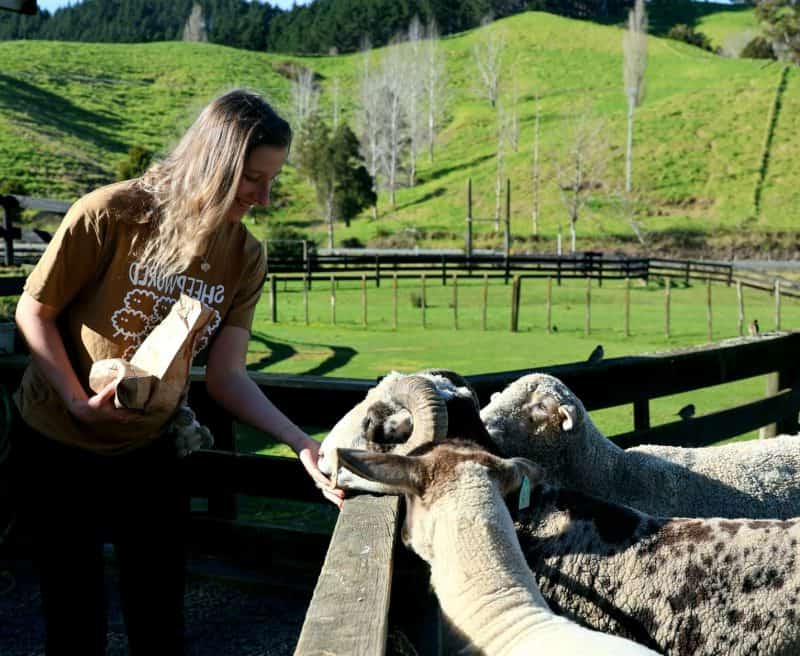
The farm also has alpacas, goats, pigs, and various other animals that can be patted, photographed, and gently prodded by curious toddlers. None of this is exotic by New Zealand standards — any rural kid would shrug — but for families from Auckland apartments and Chinese cities, the physical proximity to livestock is genuinely novel. We watched a woman from our group stand frozen for a full minute the first time an alpaca walked up and sniffed her hand. She later bought three alpaca wool scarves from the gift shop, which tells you something about the conversion rate of physical animal contact to retail spending.
The hands-on section is unstructured and unhurried. There are no queues, no timed slots, no staff member rushing you along. You wander, you touch, you take photographs. The lambs are patient. The alpacas are indifferent. The goats are opportunistic. It is twenty minutes of pure, uncomplicated contact with animals that most of us only know from screens.
Beyond the Shows
The Cafe and Gift Shop Situation
The Sheepworld cafe is fine. We want to be honest about this because travel writing has a tendency to make everything sound better than it is, and the cafe at Sheepworld is not a destination in itself. It serves coffee, sandwiches, pies, and cabinet food of the kind you find at every New Zealand rural attraction — reliable, filling, and unlikely to appear on anyone list of the best cafes in Auckland.
That said, after an hour of watching shearing demonstrations and chasing lambs, a flat white and a steak pie hits exactly right. The cafe has indoor and outdoor seating, views over the farm, and the sort of relaxed atmosphere that comes from being the only food option within a five-minute walk. Prices are fair by tourist attraction standards.
The gift shop is attached, and it leans heavily into wool and sheepskin products. Sheepskin rugs, wool blankets, possum-merino gloves, that sort of thing. For Chinese visitors, these make practical souvenirs — actual New Zealand products made from the animals you just met, which is a better story than a fridge magnet. The quality is generally good, though you will find similar products in other tourist shops around the country. If you want a proper meal, Warkworth is five minutes up the road and has several decent cafes and a supermarket.
Combining Sheepworld With a Northland Road Trip
Sheepworld sits at the southern entrance to Northland, which makes it one of the most convenient stops on the Auckland-to-Bay-of-Islands route. If you are driving north to Paihia, Russell, Kerikeri, or anywhere in the Far North, you will pass Sheepworld within the first hour of leaving Auckland. This is worth knowing because the drive from Auckland to the Bay of Islands is about three and a half hours without stops, and Sheepworld gives you a reason to break the journey with something more interesting than a petrol station.
The standard itinerary for Chinese tour groups heading north has traditionally included Sheepworld as a scheduled stop, and there is a reason for that beyond convenience. The farm experience offers a compact, accessible introduction to New Zealand rural culture that provides context for the farmland you will be driving through for the next two hours. After watching a sheep get shorn and a dog work a paddock, the endless green fields and white dots on hillsides suddenly make more sense.
Warkworth itself is worth a ten-minute wander if you have time. The town sits on the Mahurangi River, has a handful of good cafes, a Saturday market, and a chocolate factory that is popular with families. It is not a destination, but it is a pleasant place to fill up the car and buy snacks before the long stretch north.
Is Sheepworld Worth Your Time
Who Will Love It and Who Will Not
Families with children under ten — this is your stop. Sheepworld is built for kids who want to touch animals, and the shows are paced to hold young attention spans. The lambs are gentle, the arena seating means nobody has to stand, and the whole experience wraps up in about ninety minutes, which is the exact window before children start asking for the car.
Chinese visitors experiencing New Zealand farm culture for the first time will get genuine value here. If your reference point for sheep is a photograph or a cartoon, watching one get shorn in real time while a farmer explains the process in cheerful New Zealand English is the kind of experience that sticks. Several people in our group said Sheepworld was the moment New Zealand stopped being a pretty landscape they were driving through and started being a place they understood.
Couples without children who have already spent time in rural New Zealand — you can probably skip it. The shows are entertaining, but if you have seen working dogs on an actual farm or stopped at a sheep station in Canterbury, Sheepworld will feel like a polished version of something you have already encountered. As a dedicated outing from Auckland, the time commitment is hard to justify. As a stop on the way north, it is a pleasant break that costs you an hour and leaves you mildly educated.
What We Tell Friends Who Ask
When friends ask us whether they should stop at Sheepworld on their way to Northland, we say yes — but we say it with conditions. Go for the show. Seriously: plan your drive around the show schedule, not the other way around. Arriving at Sheepworld without catching the farm show is like going to a cinema and only visiting the snack bar. The animals are nice, the cafe is adequate, but the shearing and the dogs are the reason the place exists.
Give it ninety minutes. That covers one full show cycle plus time to wander, feed a lamb, drink a coffee, and browse the gift shop without rushing. If you have children, add another thirty minutes because they will not want to leave the lambs.
Mian yang (mian yang) — sheep — are woven so deeply into New Zealand identity that you cannot really understand this country without understanding what happens on a farm. Sixty million sheep in a country of five million people is not a statistic, it is a way of life. Sheepworld compresses that understanding into an accessible, slightly touristy, but fundamentally honest ninety minutes on a farm just off the highway. We think that is worth the stop. We think you will too.
Sheep are so central to New Zealand that Kiwis have stopped noticing them. They are the white dots on every hillside, the wool in every souvenir shop, the punchline to every joke about the national population ratio. For those of us who arrived from the other side of the Pacific, the relationship between this country and its sheep is one of those things that takes years to fully appreciate. Sheepworld will not give you the whole picture — it is a roadside farm, not a rural immersion programme — but it will give you the first honest chapter. And sometimes, watching a three-minute shearing demonstration is all it takes to make sixty million sheep finally make sense.
3 Comments
We took our kids here on the way to Mangawhai last month and I was surprised how much I enjoyed it myself. The sheepdog demo really is something — watching that dog respond to the different whistles and cut three sheep out of the group without barking once was genuinely impressive. My six year old has not stopped talking about the lamb feeding. Only thing I would add is that the car park can get quite muddy after rain so wear shoes you do not mind getting dirty.
Ha, the bit about the woman freezing when the alpaca sniffed her hand and then buying three scarves — that conversion rate from animal contact to retail spending is so real. My mother-in-law did exactly the same thing, except it was possum-merino gloves. She bought five pairs. We were only supposed to stop for twenty minutes.
Do they still do the show in winter? We are heading up to Auckland in July and thinking of stopping on the way from the airport. Also wondering if the cafe has improved at all — last time we went (maybe 2023?) the coffee was pretty average even by roadside standards.