
Waimangu Volcanic Valley – Walking Through the World Youngest Geothermal System
Walk through the youngest geothermal system on earth at Waimangu near Rotorua. Born from the 1886 Tarawera eruption, still steaming, still changing.
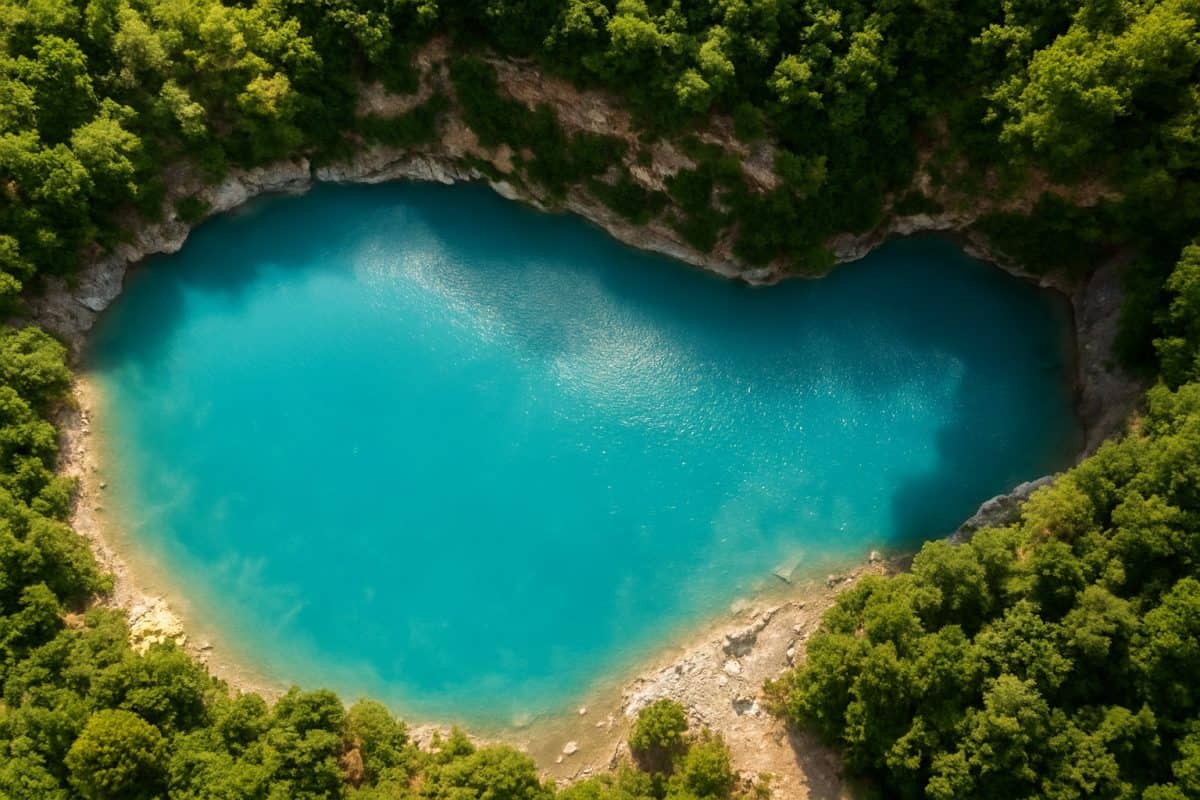
We have walked most of the geothermal tracks around Rotorua, and we keep coming back to this one. Waimangu Volcanic Valley is the youngest geothermal system on earth — born from the 1886 eruption of Mount Tarawera, still actively forming, still steaming from every surface. It is not the most famous of the Rotorua geothermal parks, and that is part of its appeal. The track walks you downhill through a valley that did not exist 140 years ago, past the world largest hot spring and a crater lake that changes colour on a 38-day cycle, and it does all of this without a gift shop at every turning point.
The Eruption That Made the Valley
June 1886 and the Night Tarawera Split Open
On the night of 10 June 1886, Mount Tarawera cracked open along a rift seventeen kilometres long. The eruption lasted roughly five hours. By dawn, more than 100 people were dead, three villages had been buried, and the landscape between Tarawera and Rotomahana had been torn apart so completely that surveyors sent to map the aftermath barely recognised the terrain. The rift valley left behind — raw, steaming, stripped to the geology — is the ground you walk through today at Waimangu.
For us, the date sticks. 1886 was the year our great-great-grandparents might have been alive, the tail end of the Qing Dynasty, and in New Zealand a volcanic eruption was remaking the landscape in a single night. It is not ancient history. In geological terms, it happened this morning. The eruption destroyed the Pink and White Terraces, which had been drawing international visitors to Rotomahana for decades, and it killed Te Ariki, the Tuhourangi chief, along with much of his community at Te Wairoa. What it left behind was a valley of raw earth and boiling water that nobody had asked for and nobody quite knew what to do with.
A Landscape That Is Still Becoming Itself
Most geothermal sites you visit feel settled. The pools have been pooling for thousands of years. The vents have been venting since before anyone was counting. Waimangu Volcanic Valley is not like that. It is 140 years old. The bush growing along the track has colonised eruption debris within living memory. The terraces are building themselves in real time — silica depositing layer by slow layer, year after year, in formations that did not exist when your parents were born.
The valley is still actively changing, monitored by GNS Science and recognised as one of New Zealand most significant geothermal sites. New thermal features appear; old ones shift or go quiet. The water chemistry in Inferno Crater Lake runs on a cycle that scientists have measured but not fully explained. Warbrick Terrace is growing. If you visit this year and again in five years, the details will be different. Compare this to somewhere like Yellowstone, where the geothermal features have been broadly stable for millennia, and the distinction is clear: Waimangu is not a museum of volcanism. It is volcanism happening now, in a valley young enough to still be finding its shape.
Walking the Valley Floor
The Track Runs Downhill and That Changes Everything
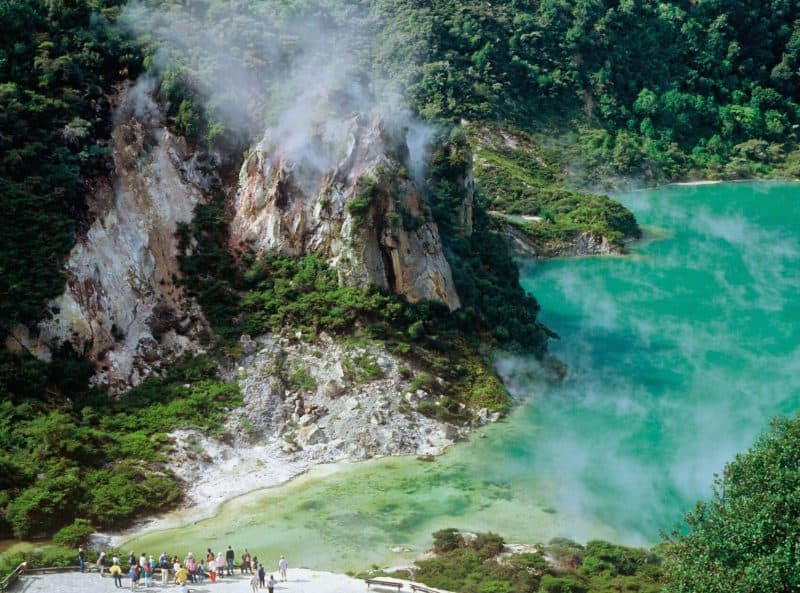
The walking track at Waimangu runs one way, downhill, from the visitor centre to the shore of Lake Rotomahana. You do not loop back. A shuttle bus collects you at the bottom and drives you to the top again, which means the entire walk has the psychological shape of a descent — you are always going deeper into the valley, always moving towards the lake, and the thermal features build in intensity as you go.
The full walk to the lake is about four kilometres and takes between ninety minutes and three hours, depending on how long you linger at the viewing platforms. There is nothing strenuous about it. The path is well-formed, the gradient is gentle, and the only reason to stop is because something has caught your eye — which happens roughly every two hundred metres. We have done walks in New Zealand that test your legs and walks that test your patience; this one tests neither. It asks for your attention, and the downhill structure means your legs are fresh enough to give it.
What You Smell Before You See It
You smell the valley before you see it. The sulphur arrives about ten minutes into the walk — not the aggressive rotten-egg blast you get at some Rotorua sites, but a steady, warm undertone that sits in the back of your throat and reminds you that the ground beneath your feet is not entirely solid. First-timers wrinkle their noses. By the halfway point, you have stopped noticing.
The steam is the other thing. It drifts through the native bush that has reclaimed the valley slopes — kanuka, ferns, mosses that have colonised the volcanic debris with a persistence that feels almost competitive. In places the steam rises from the ground beside the track itself, and the air goes warm and damp in patches. On a cold morning, the effect is extraordinary: you walk through curtains of white vapour that part and close behind you, and the bush sounds — tui, kereru, the occasional fantail escort — come and go with the visibility. It is not comfortable, exactly. But it is honest. This is what a living geothermal system feels like up close, and Waimangu does not sanitise it.
Timing, Weather, and the Crowds You Will Not Find
Waimangu sees a fraction of the foot traffic that Wai-O-Tapu or Te Puia receive. This is partly geography — it sits about twenty minutes south of Rotorua, off State Highway 5 towards the Waimangu Volcanic Valley reserve area, far enough from the main tourist strip that the coach tours often skip it — and partly reputation. Wai-O-Tapu has the Champagne Pool and the Lady Knox Geyser, which photograph well and fit neatly into a half-day itinerary. Te Puia has the cultural centre and the kiwi house. Waimangu has a walking track through regenerating bush and a series of thermal features that demand patience rather than performance. The coaches go elsewhere. For us, that is the selling point.
Morning visits are best. The steam is thickest before the day warms up, and the low light makes the colours of the thermal pools richer — milky blues and acid greens that flatten under midday sun. Overcast days, counterintuitively, are ideal for photographs: no harsh glare on the water surfaces, and the steam shows up white against grey sky rather than vanishing into blue. Winter mornings are the most dramatic, though you will want a decent jacket. The valley is open year-round, and even in January you are unlikely to share a viewing platform with more than a handful of people.
The Features That Stop You Walking
Frying Pan Lake and the Scale of the Thing
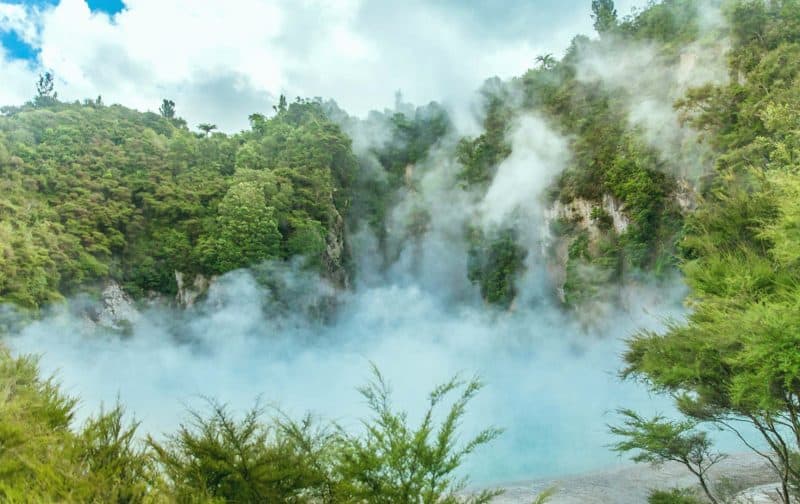
The viewing platform above Frying Pan Lake is where most people stop talking for a moment. It is not the prettiest feature in the valley — the colour is a murky blue-green, the surface is permanently obscured by steam — but the scale of it silences you. This is the largest hot spring in the world by surface area, roughly 38,000 square metres of water that averages around 50 to 60 degrees Celsius, sitting in the explosion crater left by the 1886 eruption. The name undersells it. You do not fry anything in a pan this size; you stand above it and try to process the fact that an entire lake is gently simmering.
The steam rising off the surface is constant and thick. On cool mornings it fills the crater entirely, and the lake disappears beneath a white blanket that drifts and reforms with the breeze. When it clears, you see the edges — pale silica deposits, fallen trees half-submerged in water too hot for anything to live in. There is no signage that adequately prepares you for the size of the thing. Photographs compress it into something manageable. Standing there does not.
Inferno Crater Lake and Its Moods
Further down the track, Inferno Crater Lake is the feature that earns the most photographs and the most confused expressions. It sits at the bottom of a steep-walled crater, and from the viewing platform above you look almost vertically down into water that shifts colour depending on its temperature and chemistry — turquoise on some visits, pale jade on others, occasionally a milky blue so vivid it looks artificial. The crater walls are raw and striated, stained with mineral deposits in rust and cream and sulphur yellow.
The lake rises and falls on a cycle of roughly 38 days. At its peak, the water sits high in the crater, almost placid, and the colour is at its most intense. At its lowest, it drops by up to eight metres, exposing the bare crater walls and reducing the lake to a smaller, angrier pool that steams aggressively. Nobody is entirely sure why. The cycle has been measured and documented, but the mechanism that drives it — some combination of underground pressure, water supply, and gas dynamics — remains not fully explained. You can ask at the visitor centre what stage the cycle is at on the day you visit. It is worth asking. The difference between a high lake and a low lake is the difference between serene and slightly unnerving, and both are worth seeing.
Cathedral Rocks, Silica Terraces, and Everything Between
Between the headline features, the valley is full of things that would be the main attraction anywhere else. Cathedral Rocks rise from the valley floor in dramatic columns of hydrothermally altered rock — pale, sculptured cliff faces that look like they belong in a canyon rather than a New Zealand bush walk. Boiling pools appear beside the track without ceremony, their surfaces busy with rising bubbles and the occasional gust of steam. The smell shifts from section to section — stronger here, almost absent there, sharp and metallic near the acidic pools, softer and more sulphurous near the vents.
The silica terraces along the lower section of the track are among the youngest geological formations you will ever see. They are building themselves from the mineral-rich water that flows over them, adding thin layers of silica deposit season by season. Warbrick Terrace, named after one of the guides who was present during the 1886 eruption, is growing at a rate you could measure in a human lifetime. The cumulative effect of walking through all of this — the boiling pools, the steaming vents, the cliffs and terraces and the constant background heat — is what separates Waimangu from a park with two or three set-piece attractions. The thermal activity is not confined to viewing platforms. It is the entire valley.
Down to the Lake and the Boat That Goes Further
Lake Rotomahana by Boat
At the bottom of the valley walk, the track meets the shore of Lake Rotomahana. You can catch the shuttle here and head back to the visitor centre, or you can add a boat cruise that takes you out onto the lake itself. We would recommend the cruise at least once. The lake was reshaped entirely by the 1886 eruption — before that night, Rotomahana was a much smaller, shallower lake, famous primarily as the body of water at the foot of the Pink and White Terraces. The eruption blew the basin wide open, and what filled in is a deeper, larger lake with steaming cliffs along much of its shoreline.
The cruise runs for about 45 minutes and follows the lake edge, passing geothermal features that are invisible from the walking track — steaming vents at the waterline, mineral-stained rock faces, patches of bush that have somehow taken hold on near-vertical cliffs above boiling water. The birdlife is good. Black swans, shags, and occasionally a white heron work the shoreline, apparently unbothered by the steam. It is a quieter experience than the walk itself — more contemplative, less dramatic — and it gives you a sense of the eruption scale that the valley floor alone does not convey. The lake stretches further than you expect. So does the thermal activity along its edges.
What the Pink and White Terraces Used to Be
Before the eruption, the Pink and White Terraces — Te Otukapuarangi and Te Tarata — were considered the eighth wonder of the natural world. They were massive formations of silica terraces, cascading in broad, shallow steps down to the shore of the original Lake Rotomahana, fed by hot springs that deposited mineral-rich water in pale pink and brilliant white. European tourists had been making the journey to see them since the 1850s, arriving by coach and then by Maori-guided waka across the lake. They were, for a time, New Zealand most famous attraction — drawings and early photographs circulated internationally, and the Terraces were a genuine reason for people on the other side of the world to consider a voyage to the South Pacific.
The eruption buried them. For over a century, it was assumed they were destroyed entirely. In the 2010s, researchers using sonar and bathymetric mapping found formations on the lake floor that may be remnants of the original terraces, though the interpretation is debated. What is not debated is the loss. Walking through Waimangu, you are walking through the landscape that replaced something people once crossed oceans to see. The valley is extraordinary on its own terms, but there is a quiet sadness underneath the spectacle — the knowledge that the same eruption that made this place destroyed another one that can never be remade.
Waimangu does not perform for you the way some geothermal parks do. There is no geyser on a timer, no boardwalk over a photogenic pool with a name designed for Instagram. What it offers instead is a valley that is still in the process of becoming something, shaped by an eruption that happened recently enough to feel personal. You walk downhill through it, you smell it, you feel the warmth of it underfoot, and you leave knowing that the next person to walk the same track will see a slightly different place. Ziran — the Chinese concept of things being as they are, unforced — is not a word that comes up in the brochures. But it is the word that fits.
2 Comments
Done this walk maybe six or seven times now and the tip about going in the morning is absolutely right. The steam through the kanuka in low light is something else. I have been lucky enough to see Inferno Crater at both ends of the 38 day cycle and the difference is wild — full and turquoise one visit, dropped right down and angry looking the next. Asked at the desk last time and they told me the exact day in the cycle which was really helpful. Also the boat cruise on Rotomahana is worth the extra cost. The steaming cliffs along the shoreline are features you just cannot see from the track.
Never thought about it before but you are right that the one-way downhill design changes the whole experience. Legs stay fresh, you just focus on what is around you. Sweet as.