
The Kauri Museum Matakohe – Northland Giant Trees and Gum-Digging History
Inside the Kauri Museum at Matakohe -- thousand-year timber slabs, gum-digger history, and why this small Northland museum is worth the detour.
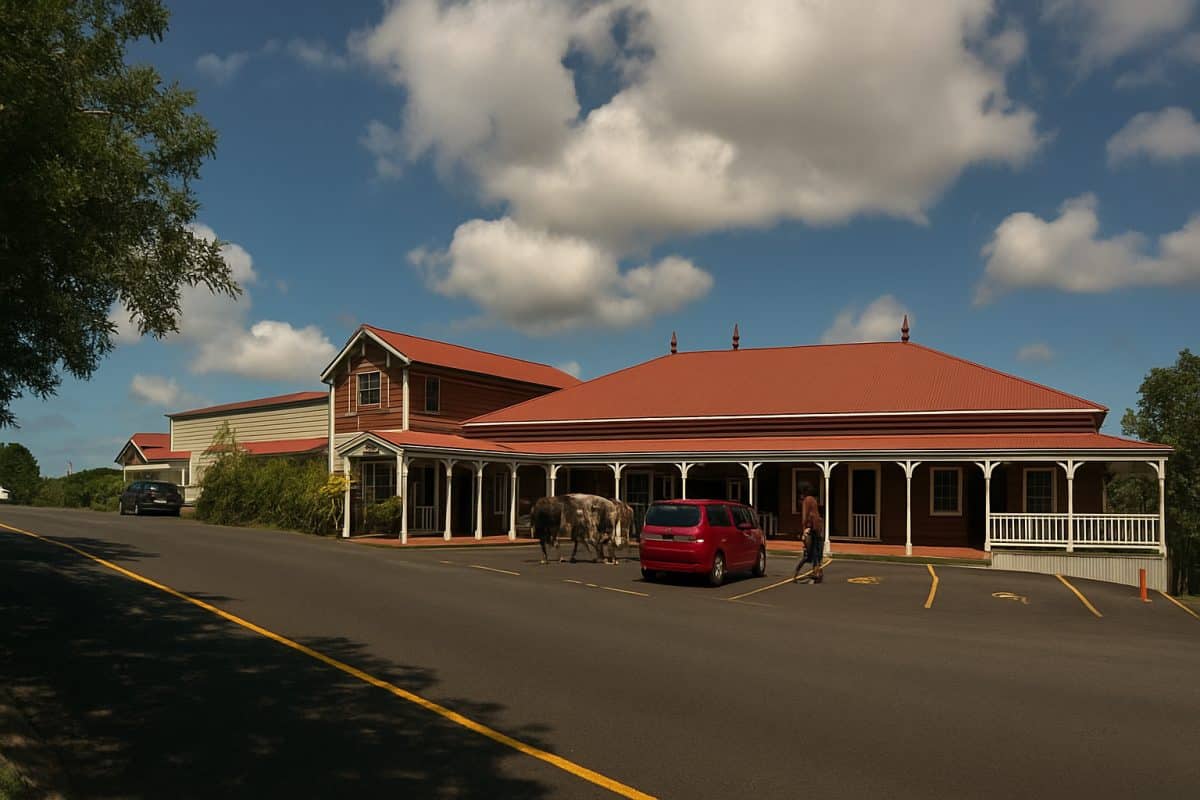
We almost drove past the Kauri Museum in Matakohe. A brown sign, a left turn off State Highway 12, and a car park that suggests nothing about what is inside — this is not a museum that advertises its own scale. What it contains is a record of Northland kauri that covers a thousand years of tree growth, a century of industrial logging, and the strange, beautiful afterlife of kauri gum buried in swamps for millennia. We have visited twice now, and both times we emerged into the car park slightly altered, carrying a weight of historical context that makes every kauri tree you see afterwards feel like a different encounter.
The Building You Almost Drive Past
Matakohe Is One Petrol Station and a Museum
Matakohe is the kind of Northland settlement that does not announce itself. You are driving State Highway 12 between Brynderwyn and Dargaville, the road is winding through green dairy country, and then there is a speed sign, a petrol station, a handful of houses, and a brown tourism sign pointing left. That is it. If you are not looking for the Kauri Museum, you will not find it. We nearly missed it the first time — someone in the back seat was asleep, someone in the front was arguing about whether to stop for petrol, and the sign went past before anyone registered what it said.
The town sits about ninety minutes north of Auckland if you take the inland route, or an hour from Whangarei if you come from the east. Neither drive is short, and there is nothing else in Matakohe that would bring you here. The museum is the reason the town appears on maps at all. From the car park, it looks like a modestly sized regional museum — the kind of place you walk through in twenty minutes and feel like you have done your cultural duty. That impression lasts exactly as long as it takes to get through the front door.
First Impressions and the Entry Hall
The entry hall is where the Kauri Museum stops being a small-town curiosity and starts being something else entirely. There are polished kauri slabs mounted on the walls — cross-sections of trees so wide that your first instinct is to check whether they are real. They are. Some of these slabs are over two metres across, cut from trunks that were already ancient when the first European ships arrived in New Zealand waters. The grain runs in long, sweeping curves, and the polish brings out colours that range from pale honey to deep reddish brown.
What gets you is not any single piece but the accumulation. Slab after slab, each one labelled with the estimated age of the tree it came from. Six hundred years. Eight hundred. One thousand. You stand in front of a cross-section and try to do the arithmetic — this tree was a sapling when the Song Dynasty was at its height, and it was still growing when someone cut it down in 1910. The museum lets you do that arithmetic at your own pace. There are no multimedia presentations or flashing displays. Just wood, light, and the slow realisation that you are looking at something that took a millennium to build and a morning to fell.
How Long to Allow and What It Costs
Adult admission is around $25, with discounts for families and children — check the Kauri Museum website for current pricing. The museum is open daily from 9am to 5pm, though hours may vary in winter — check before you drive out if you are visiting between June and August. There is a small cafe on site that does reasonable coffee and cabinet food, enough for lunch if you are not fussy.
Allow at least ninety minutes. Two hours is more realistic if you read the display panels, and three hours disappears easily if you wander into the gum room and the pioneer settlement recreations. We have met people in the car park who planned a quick stop and emerged blinking two and a half hours later, slightly dazed and full of opinions about colonial forestry. The museum is bigger than it looks from outside, and the rooms keep leading into more rooms. Budget your time generously, especially if you are continuing north to Waipoua Forest afterwards — you do not want to rush this place and then rush the forest too.
What a Thousand Years Looks Like in Cross-Section
The Timber Gallery and Its Largest Pieces
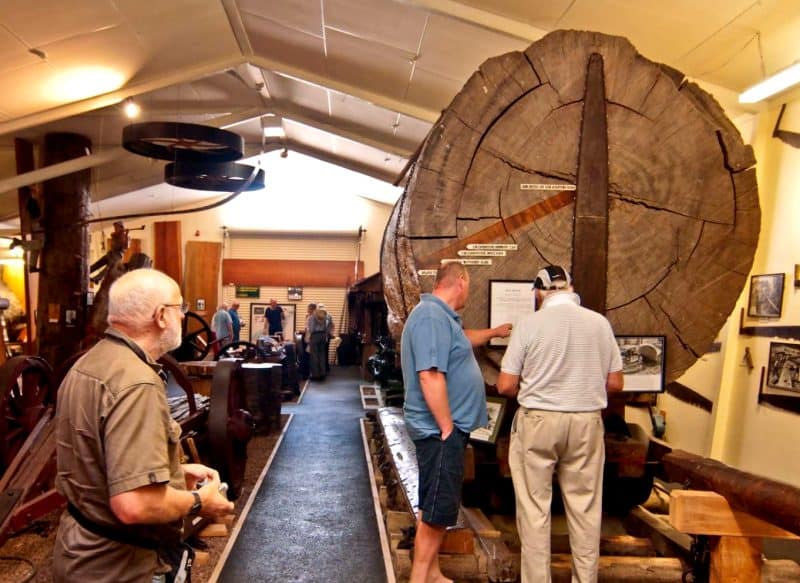
The timber gallery is the heart of the museum and the thing that stays with you longest. The kauri slabs here are not just large — they are the kind of large that forces you to recalibrate your sense of what a tree can be. The centrepiece is a massive cross-section, polished to a mirror finish, that spans well over two metres. Stand next to it and your arms will not reach halfway across. The ring count on some of these pieces runs into four figures.
There is a staircase built from a single kauri trunk, and furniture — tables, desks, cabinets — made from individual pieces of timber that would be considered extraordinary in any other context but here are almost unremarkable because everything in the room is on the same scale. The craftsmanship in the finished pieces is beautiful, but what stops you is the raw material itself. These were trees that started growing when Chinese poets were writing about the forests of Hangzhou. They stood through the Yuan Dynasty, the Ming, the Qing, and they were felled by men with crosscut saws in the space of a Northland afternoon.
Why Kauri Grew So Large and Why They Stopped
Kauri — Agathis australis — is an ancient species, a conifer that predates most of the flowering plants it now shares its forests with. They grow slowly, sometimes taking centuries to reach full maturity, and in the right conditions they grew enormous: trunks up to five metres in diameter, heights above fifty metres, crowns that emerged above the canopy like green watchtowers. Northland and the upper North Island provided those conditions — warm, wet, sheltered from the worst winds — and before human arrival the kauri forests were vast.
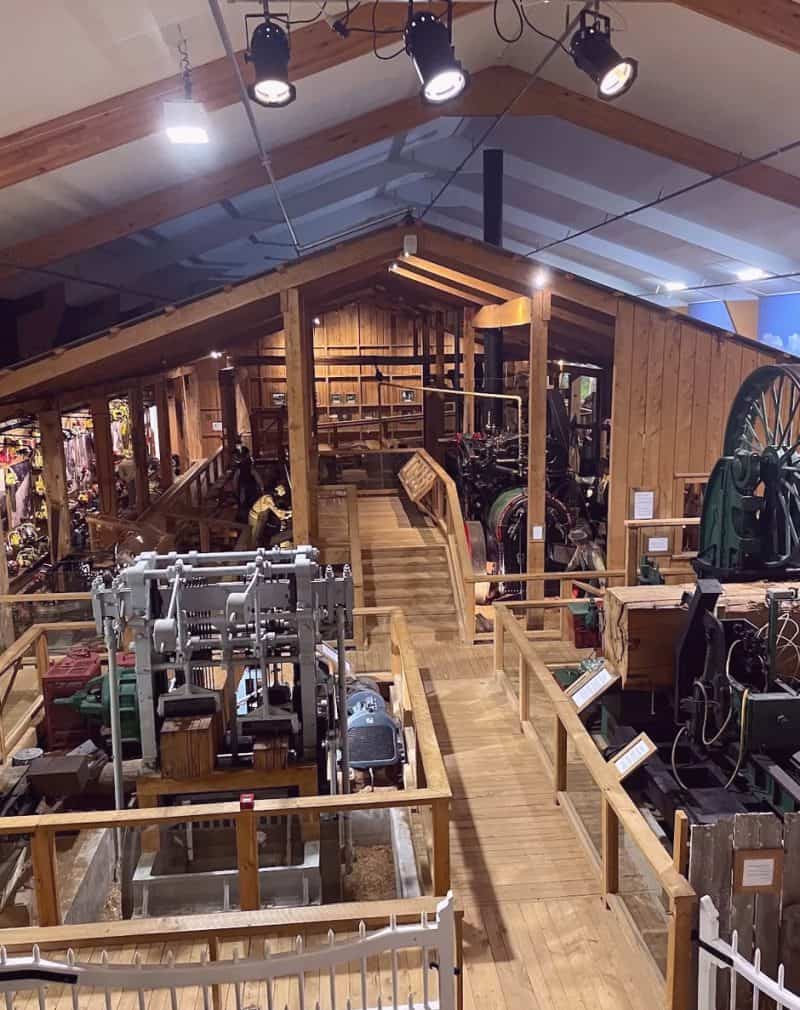
Then came the timber industry. From the mid-1800s through the early twentieth century, the kauri forests were logged with an efficiency that is difficult to comprehend from a modern distance. The museum displays the tools and methods honestly — the massive crosscut saws, the bullock teams dragging logs through mud, the kauri dams that were built and then deliberately broken to flush logs downstream in a wall of water. There are photographs of men standing on stumps the size of small rooms, grinning. The displays do not editorialise, but the emotion is right there in the room: pride in the work and grief at what it cost. You can hold both feelings at the same time, and the museum trusts you to do that.
Swamp Kauri and the Ancient Buried Logs
Then there is the swamp kauri, and this is where the timescale becomes genuinely difficult to hold in your head. Buried beneath Northland peat bogs are kauri logs that fell tens of thousands of years ago — trees that toppled in storms or floods during the last ice age and were preserved by the anaerobic conditions in the swamp. The museum has specimens of this wood, and when you read the labels you have to read them twice. Thirty thousand years old. Forty-five thousand. Fifty.
These are not fossils — they are actual wood, still workable, still beautiful when cut and polished. Some of the swamp kauri pieces in the museum predate the arrival of humans in New Zealand by forty thousand years. Scientists use them for radiocarbon calibration and climate research, because the tree rings record atmospheric conditions from a period when the planet was a very different place. For us, standing in front of a polished slab of wood that was alive during the last glacial maximum, the scientific value was secondary to the sheer strangeness of the object. You are looking at something that grew in a world where this land had no people on it at all.
The Gum-Diggers and the People Who Came for Kauri
What Kauri Gum Actually Is
If you have never encountered kauri gum before, think of it as New Zealand amber — hupo, if that reference lands faster. It is fossilised resin, produced by kauri trees and buried in the soil for thousands of years, hardening slowly into translucent lumps that range from pale lemon to deep burnt orange. Some pieces are the size of a fist. Some are the size of a rugby ball. The museum has a gum collection that would make a geology department quietly envious, displayed in cases that catch the light and make the whole room glow.
The gum was commercially valuable because of its chemical properties — it made excellent varnish, and it was a key ingredient in linoleum, which was the dominant flooring material of the early twentieth century. At its peak, kauri gum was one of New Zealand exports that actually mattered to international markets. Some of the museum pieces have insects trapped inside, frozen in resin the way amber preserves specimens anywhere in the world. There is something universally compelling about seeing a perfectly preserved insect in a piece of material that is older than most human civilisations. The gum room is one of those galleries where you go in planning to spend five minutes and come out twenty minutes later having examined every case.
The Gum-Digging Life Was Brutal
The people who dug this gum out of the ground lived hard. Gum-digging was manual labour in Northland bush and swamp — you dug with a spear-shaped probe until you struck a lump, then excavated it by hand from the clay. The camps were rough. The pay was unpredictable. The work attracted people who had limited options, and in Northland that meant a particular mix: Maori communities who had been working the gum fields for decades before Europeans arrived, itinerant workers drifting north, and Dalmatian immigrants who crossed the world specifically for this.
The Dalmatian story is the one the museum tells with particular care. These were men from what is now Croatia — mostly from the coastal regions of Dalmatia — who arrived in New Zealand in the late nineteenth and early twentieth centuries and headed straight for the gum fields. They lived in isolated camps, saved what they could, and many of them eventually settled in Northland permanently. Their descendants run vineyards and farms across the region today. For anyone who has moved to a new country to do difficult work and build a life from scratch, the gum-digger story has a familiar shape. We stood in front of the camp recreation and recognised something — not the specific details, but the pattern.
The Pioneer Boarding House and Settlement Rooms
The museum has assembled a series of walk-through recreations that cover settler life in the Northland of the 1800s and early 1900s. There is a colonial boarding house with period furniture and utensils, a settler kitchen with a cast-iron range and crockery that looks like it was used yesterday, and a schoolroom with wooden desks and a blackboard. These are not the usual dusty mannequin dioramas that small-town New Zealand museums default to — someone has taken real care with the details.
What makes the recreations work is the specificity. The boarding house has individual rooms dressed with different levels of comfort, suggesting the economic range of the people who would have stayed there. The kitchen has a particular set of tools on the wall — each one identifiable, each one functional. There is a general store stocked with replica goods and a post office with ledgers. You could walk through quickly and get the general impression, or you could slow down and read the labels on the tins and the names in the ledgers and the notices pinned to the walls. The museum rewards the second approach. Most of the people in these rooms were anonymous — the kind of settlers who do not make it into history books — and the recreations give them back a little of the texture of their daily lives.
Kauri Dieback and Why This Museum Matters Now
The Disease That Is Killing the Survivors
The survivors of the logging era face a new threat, and this one does not carry a crosscut saw. Kauri dieback is caused by Phytophthora agathidicida, a water mould that infects kauri roots and slowly starves the tree. It spreads through contaminated soil — a pinhead of infected dirt on a boot or a bicycle tyre is enough. There is no cure. Infected trees die over years, their canopies thinning, their bark weeping, their roots rotting in soil that looks perfectly normal from the surface.
The remaining mature kauri — the great trees in Waipoua Forest, the scattered survivors in Northland reserves — are under genuine threat. Track closures and shoe-washing stations have become standard at every kauri walking track, and the anxiety in the Northland conservation community is real and justified. The museum addresses kauri dieback directly, and the timing of the display matters. You have just spent two hours looking at what the kauri forests once were, how vast and how ancient. Then you learn that the trees which survived the saws might not survive a microscopic organism in the mud. It is a gut punch that the museum does not need to dramatise — the facts do the work.
Visiting Waipoua Forest After the Museum
The natural continuation of a Kauri Museum visit is the drive north to Waipoua Forest, and we would argue this is the correct sequence. See the museum first. Understand the scale of what was felled, the age of what grew, the history of the people who worked the kauri in every form. Then drive fifty minutes up State Highway 12 through Dargaville and into the forest where Tane Mahuta still stands.
Tane Mahuta — the Lord of the Forest — is the largest known living kauri, and seeing it after the museum is a different experience from seeing it cold. You know what the cross-section of a tree this size looks like. You know how old it probably is. You know about the gum and the logging and the dieback, and all of that context sits with you as you stand on the boardwalk and look up into a canopy that has been there for somewhere between 1,200 and 2,500 years. The museum gives you the vocabulary to understand what you are seeing. Without it, Tane Mahuta is a very large tree. With it, Tane Mahuta is a survivor — and you understand exactly what it survived.
Matakohe is not on the way to anywhere most people are already going, and the Kauri Museum asks for a deliberate detour. It repays that detour several times over. There is something about standing in a room full of wood that took a thousand years to grow — wood that was ancient before anyone in your family line set foot in this country — that recalibrates your sense of time in New Zealand. The museum does not tell you how to feel about any of it. It just shows you what was here, what was done, and what remains. The feeling part, it trusts you with.
2 Comments
Completely agree about doing the museum before Waipoua Forest. We did it the other way round on our first trip — saw Tane Mahuta, thought “big tree, cool” and moved on. Went back years later, did the museum first, then drove up to the forest and it was a completely different experience. Understanding the logging history and then standing in front of a survivor changes everything. The swamp kauri section blew my mind too, forty-five thousand year old wood that you can still work with is just absurd.
Good to see the Dalmatian gum-digger story getting a mention. My nan grew up near Dargaville and she reckons the Croatian families and the local Maori whanau had a lot of respect for each other on the gum fields. Different backgrounds but same hard work. The museum does a decent job of telling that side of it.