
Larnach Castle – Dunedin Dramatic Castle on the Otago Peninsula
NZ only castle sits on the Otago Peninsula above Dunedin harbour. Dramatic history, 14 hectares of gardens, and tower views worth the drive.
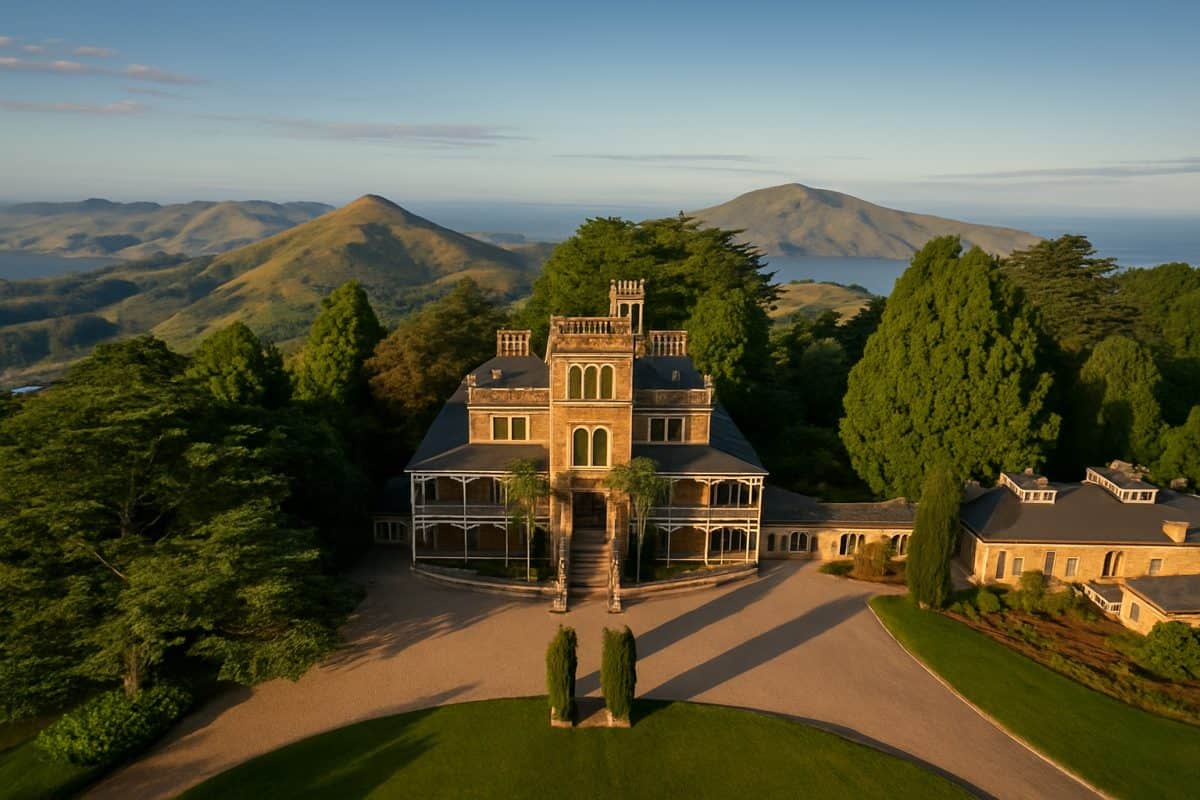
William Larnach built New Zealand its only castle on a windswept ridge above the Otago Peninsula in 1871, and the story of what happened next is one of the most dramatic in the country. We drove out the peninsula road on a Tuesday afternoon, climbed the tower, walked the gardens, and came back with the kind of visit that stays with you — part architectural tour, part family saga, part harbour panorama that makes you forget to check your phone.
A Banker, a Castle, and the Worst Luck in New Zealand
William Larnach Built an Empire and Then a Castle
The story of Larnach Castle starts with the kind of ambition that only makes sense in a colony. William Larnach arrived in Dunedin from Melbourne in the 1860s, during the gold rush years when Otago was briefly the wealthiest province in New Zealand. He was a banker — shrewd, connected, eventually political — and he married Eliza Guise, the daughter of a French aristocrat. In 1871, with money flowing and social standing to cement, he decided to build a castle on a ridgeline above the Otago Peninsula.
Not a large house. Not a manor. A castle. He imported Italian marble, Venetian glass, and tiles from England. He hired two hundred workers and kept them busy for three years on the shell alone, then spent another twelve years on the interior. The ballroom ceiling was carved by three European craftsmen. The entrance hall was panelled in native timbers — rimu, kauri, totara — as if to say that this was a European vision built from New Zealand wood. The whole project cost an estimated sum equivalent to tens of millions in today’s currency. In a young colonial city at the bottom of the Pacific, one man decided that what the landscape needed was a castle, and then he built one.
We have a particular sympathy for this kind of gesture. You leave one country, arrive in another, and something in you wants to make a mark so permanent that nobody can pretend you were never here.
Three Wives and a Parliament That Did Not Care
Larnach’s castle outlasted his happiness. Eliza died in 1880, not long after the family moved in. He married her half-sister Mary, who also died within a few years. His third marriage, to Constance de Bathe Brandon, was by most accounts a miserable arrangement. His financial interests faltered as the colonial economy tightened. He served as a Member of Parliament and then as a Minister of the Crown, but politics brought him frustration rather than consolation — he felt ignored by colleagues who saw him as a relic of the gold-rush era.
On 12 October 1898, William Larnach shot himself in a committee room of Parliament Buildings in Wellington. He was sixty-five. The newspapers reported it with the blunt brevity of the era. The castle he had spent a lifetime building passed out of his family’s hands almost immediately.
There is no way to write about Larnach Castle without sitting with this part of the story. The building you walk through today is the physical record of one man’s determination to build something extraordinary, and the personal catastrophe that unravelled alongside it. We do not find it morbid. We find it honest. The castle does not hide from its own history, and neither should its visitors.
Fifty Years of Ruin Before the Rescue
After Larnach died, the castle went through the kind of decline that seems almost designed to test whether a building deserves to survive. It was used as a mental asylum for a time. It was sold and resold. The gardens went wild. The interiors were stripped. By the middle of the twentieth century, it was a ruin — roof leaking, walls crumbling, the marble and glass and carved ceilings slowly being consumed by Dunedin’s damp coastal air.
In 1967, a Dunedin couple named Margaret and Barry Barker bought the castle and its grounds. The price, by all accounts, was modest — ruin is cheap. What followed was not modest at all. The Barkers began a restoration project that has now continued for more than fifty years across multiple generations of their family. They did not have a heritage trust or a government grant. They had stubbornness, and apparently limitless patience for plasterwork.
The castle you visit today is the result of their obsession. Every restored room, every replanted garden bed, every piece of recovered history is a Barker family project. In a way, the restoration story mirrors the original construction — one family, seized by an impractical vision, refusing to stop. We respect this enormously. It is the kind of commitment that transcends common sense and becomes something closer to devotion.
What You Actually See When You Walk Through the Door
The Rooms That Tell the Story
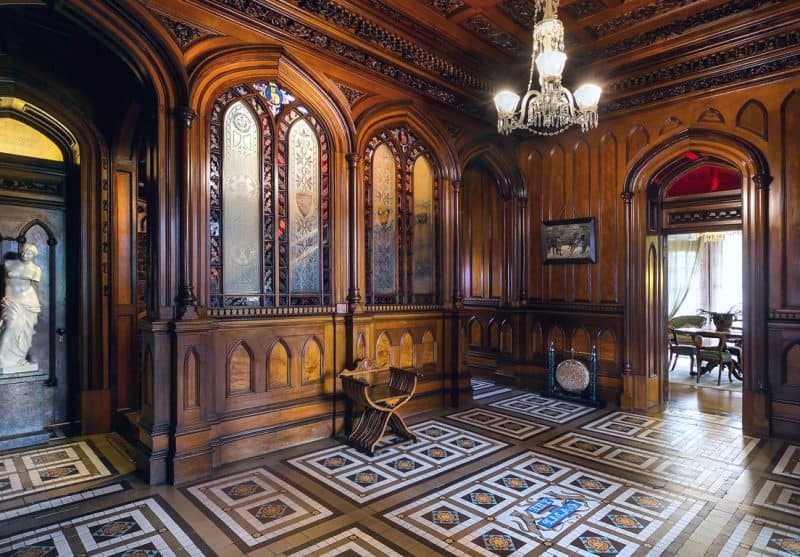
You step through the front door into a hallway panelled in dark native timber, and the scale of what Larnach attempted hits you immediately. This is not a grand country house that someone later called a castle for marketing purposes. It was designed as a castle from the first sketch — turrets, a tower, a dungeon, formal rooms arranged for entertaining on a scale that colonial Dunedin could barely justify.
The carved staircase rises through the centre of the house like a spine. The Georgian hanging staircase is a particular piece of craftsmanship — it appears to float without visible support, a structural trick that was fashionable in the 1870s and still impresses today. The ballroom is the showpiece: that ceiling, carved from dense hardwoods by European artisans, took years to complete and survived the decades of neglect largely intact because it was too solidly built to collapse.
What strikes you as you move through the rooms is the mix of grandeur and intimacy. The castle is not enormous by European standards — you could fit the whole building into one wing of a proper English stately home. But that compression works in its favour. You feel the ambition in every room without being overwhelmed by it. The personal effects, the family photographs, the information panels that trace the Larnach story room by room — they keep the building human. This is not a museum of wealth. It is the house of a man who wanted everything and got most of it before it all went wrong.
The Tower and What It Looks Down On
The climb up the castle tower is steep and narrow, the kind of staircase that reminds you this was built when people were smaller and less concerned about building codes. At the top, the observation deck opens onto one of the finest views on the Otago Peninsula, and possibly in Dunedin.
To the north, the harbour stretches toward Port Chalmers and the open sea beyond. The water changes colour with the weather — steel grey on overcast days, an unlikely blue when the sun finds it. To the south, the peninsula rolls away in a patchwork of farmland and native bush, dropping to rocky coastline that you cannot see but can sense at the edges. On a clear day, which in Dunedin is never guaranteed but always rewarding, you can trace the entire length of the harbour and pick out the container ships waiting at Port Chalmers.
We stood up there on a February afternoon with the wind doing its best to rearrange us, and thought about what Larnach saw from this same spot. The same harbour. The same hills. The same light catching the water in the late afternoon. He chose this ridgeline because it commanded the view, and the view has not changed. The ships are different, the farmland patterns have shifted, but the bones of the landscape are exactly what he looked at a hundred and fifty years ago. That continuity is part of what makes the Heritage New Zealand-listed castle feel less like a museum and more like a place where time has simply accumulated.
Fourteen Hectares of Garden That Nearly Disappeared
The South Seas Garden and the Alice Lawn
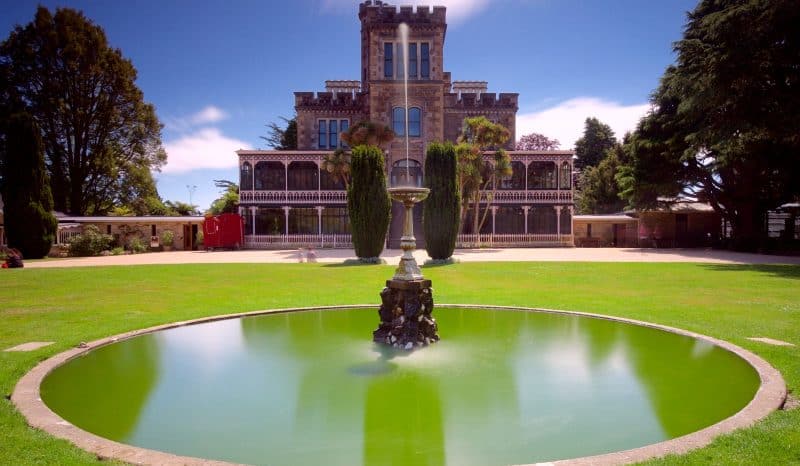
Larnach planted his gardens with the same conviction he brought to the house — nothing modest, nothing accidental. The fourteen hectares of grounds include the South Seas Garden, which takes advantage of the peninsula’s sheltered microclimate to grow subtropical species that have no business thriving this far south. Nikau palms, tree ferns, and species from the Pacific sit alongside European plantings in a combination that should not work but does, because the Otago Peninsula has its own ideas about what can grow where.
The Alice Lawn is the formal counterpoint — a manicured open space that gives you a clear view of the castle from below and reminds you that this was designed as an estate, not just a house with some trees around it. Beyond the formal areas, the rainforest walk takes you through mature native bush that has been allowed to grow back around the garden edges, blurring the line between cultivated and wild.
Seasonal timing matters. Spring brings the rhododendrons and azaleas into absurd colour — we visited in October once and the garden borders looked like someone had spilled paint across the hillside. Summer is lush and full. Autumn brings the deciduous trees into their own. Winter is quieter but not empty — the structure of the gardens shows through when the leaves drop, and Dunedin’s mild coastal winter keeps things greener than you would expect for a city that markets itself as Scottish.
Walking the Grounds With the Harbour Below
Give yourself at least an hour for the gardens, and do not make the mistake of treating them as a walk between the car park and the castle entrance. The paths wind through mature trees that throw shade in unexpected patterns, and the views appear and disappear as you move — a glimpse of harbour through a gap in the canopy, then bush, then a formal border, then suddenly the whole harbour laid out below you.
The old stables and courtyard sit at the lower end of the garden, restored and repurposed as part of the cafe and visitor facilities. There is something pleasing about drinking a flat white in a building that once housed William Larnach’s horses. The courtyard catches the afternoon sun in a way that makes you forget you are supposed to be doing something more productive with your day.
We have watched people rush through the gardens to get to the castle, and we have watched people linger in the gardens and run out of time for the castle. Both groups miss the point. The castle and the gardens are one thing — Larnach designed them as a single composition, the house sitting on its ridge with the gardens cascading below it. The best way to experience it is to arrive with enough time for both, and to treat the whole property as a single visit rather than a castle tour with a garden attached.
The Drive Out and the Option to Stay the Night
The Otago Peninsula Road Is Half the Experience
Getting to Larnach Castle means driving the Otago Peninsula road, and this is not a complaint. The route from central Dunedin follows Portobello Road along the harbour shore, a winding, scenic, occasionally narrow drive that takes about thirty minutes if you do not stop, and considerably longer if you do. You will want to stop.
The harbour side of the peninsula is sheltered and calm — small bays, boatsheds, the fishing village of Portobello itself, which has a cafe and a marine research station and not much else, which is exactly the right amount. On the ocean side, the landscape is wilder: farmland dropping to cliffs, colonies of seabirds, and the Royal Albatross Centre at Taiaroa Head, where the only mainland breeding colony of northern royal albatross in the world goes about its business on a windswept headland.
The peninsula is worth a full day even without the castle. Between the albatross colony, the yellow-eyed penguin reserves, the seals at Pilots Beach, and the general beauty of the drive, you could fill a day and never walk through a castle door. We recommend combining Larnach Castle with at least one wildlife stop — the penguin viewing platforms at several points along the peninsula are extraordinary, and the drive between them passes directly below the castle on its ridge.
Sleeping in a Castle (or at Least Next to One)
If you have ever wanted to sleep in a castle — or at least adjacent to one — the Camp Estate offers accommodation on the castle grounds. The rooms are in the original farm buildings and lodge, not in the castle itself, but the grounds are the same and the morning experience is worth the booking.
We stayed on an autumn evening when the day visitors had gone and the peninsula was doing its quiet thing — just wind, sheep, and the harbour darkening below. Waking up on the castle grounds before the gates open to the public is the closest you will get to understanding what it might have felt like to live here. The gardens in early morning light, without another person in sight, have a quality that the daytime crowds cannot quite replicate.
The accommodation is not luxury hotel standard. The rooms are comfortable, clean, well-maintained, but this is a heritage property on a windswept ridge, not a Queenstown boutique lodge. What you are paying for is the setting and the atmosphere — dinner in the castle dining room with the harbour view, the walk back to your room through the gardens in the dark, the sense of being somewhere genuinely unusual. Book ahead in summer, when the rooms fill quickly. In winter, you might have the whole estate to yourself, which is its own kind of luxury.
Larnach Castle is not the kind of attraction you consume and forget. It is the kind that accumulates — the history settles in as you drive back along the harbour road, the view from the tower resurfaces at odd moments, and the story of a man who built something extraordinary at the edge of the world and then lost everything stays longer than you expect. New Zealand has one castle. It is worth the drive.
4 Comments
Stayed at the Camp Estate in June and had the whole place to ourselves. You are not kidding about the morning experience — walking through the gardens before anyone else arrives with just the harbour below and the wind is something else. The rooms are basic but honestly who cares when you are waking up on a castle estate. Dinner in the castle dining room was a bit surreal in the best way.
The bit about “you leave one country, arrive in another, and something in you wants to make a mark so permanent that nobody can pretend you were never here” — that really landed. My parents came from Fujian in the 90s and I reckon they would understand Larnach better than most. Different scale obviously but the impulse is the same. Also did not know the Georgian hanging staircase was a thing, looked it up and now I want to go back just to look at it properly.
We combined Larnach with the albatross colony at Taiaroa Head like you suggested and it made for an incredible day. The castle in the morning, lunch at Portobello, then the albatrosses in the afternoon. Seeing a bird with a three metre wingspan land on a headland you drove to is genuinely unreal. Would recommend doing it in that order because the castle gardens are nicer in morning light.
Slight pushback on calling it “New Zealand’s only castle” — there is Doune Castle in Canterbury and a few other places that could argue the point. But I take your meaning, Larnach is the real deal in terms of scale and intent. The Barker family restoration story over fifty years is extraordinary, especially doing it without government funding. That is proper stubbornness and I mean that as a compliment.